
Our Process
The craft behind repointing a chimney in Taintsville
Chimney mortar types under ASTM C270
ASTM C270, the standard specification for mortar for unit masonry, sorts mortar into Types M, S, N and O. The Brick Industry Association describes Type N as a general all-purpose mortar, Type S as a stronger all-purpose mortar and Type O as a low-strength mortar used mostly for interior work and restoration.
For chimney brickwork, BIA Technical Note 19B recommends Type N portland cement-lime mortar and accepts Type S where higher lateral loads call for it. Repointing adds the compatibility rule on top of that, so an older chimney may take a softer type than new construction would. We explain the choice for your chimney in plain terms.
Mortar joints that hold the flashing
Where a brick chimney meets the roof, the counterflashing is usually set into a mortar joint. BIA Technical Note 19B describes it inserted 3/4 to 1 inch into the joint and mortared solidly in place, lapping the base flashing below. When that joint erodes, the flashing can loosen and let water in behind it.
Repointing near the roofline therefore includes a close look at the flashing joints. If the metal is sound, the joint is repointed around it. If the flashing itself is bent, rusted or too short, we price flashing repair separately so you can see both lines.
What a tuckpointing estimate should say
A useful repointing estimate names the faces and the area of joints to be cut out, the removal method, the mortar type and how color will be matched. It also separates the joint work from brick replacement, crown repair or flashing, so each can be approved or deferred on its own.
Ours is written that way, with upfront pricing and no hidden fees. If more failed mortar turns up once the work is under way, we stop and show you before going further, and nothing is added without your approval.
Grit on the roof and gaps between bricks
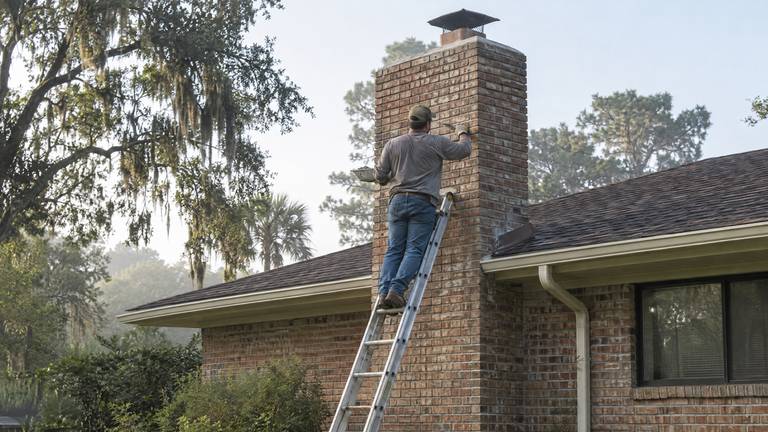
Mortar that is washing out leaves clues. Sandy grit collects on the roof below the chimney or on the ground at its base, joints look recessed behind the brick faces, and in places a shadow line opens between a brick and the mortar beside it.
None of those signs tells you how deep the damage goes. The free inspection does. Our local specialists check the joints close up and tell you whether the chimney needs a few joints repointed, a full face or a different repair altogether.


