
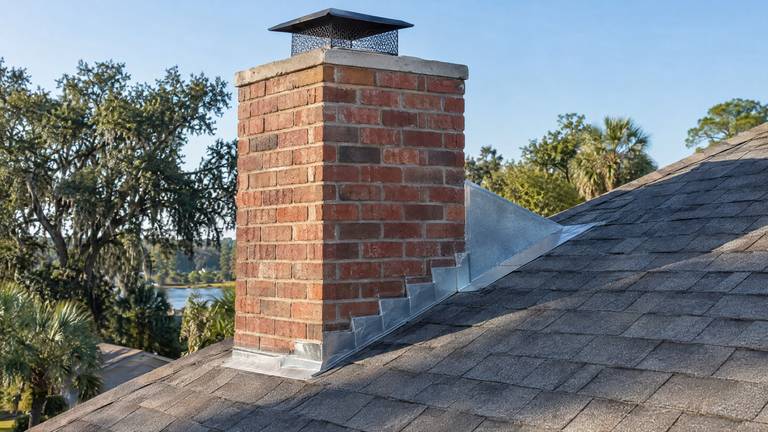
Assess the roof-to-chimney connection
A bead of sealant around the chimney may be the most obvious feature, but it is not the whole weather detail. Flashing relies on the arrangement of metal and adjoining materials to direct water. Sealant used in an appropriate joint has a role; spreading more over a failed assembly does not necessarily restore the layers below.
We examine accessible edges, changes in direction and the connection to the chimney surface. Earlier repairs may conceal part of the arrangement. If removal is needed to assess the detail, we explain that access decision. The aim is to establish what the junction needs, rather than assume the most visible crack is the entire defect.
Shingle, tile, metal and other roofing arrangements have different requirements at a penetration. A detail copied from a different covering can leave the intended drainage path incomplete. The roof condition also matters: sound new flashing cannot make deteriorated surrounding roofing serviceable.
Our assessment identifies the chimney connection and where roofing work may need another trade. Before work to reflash a chimney begins, establish who lifts, replaces or restores the adjoining covering. This coordination is particularly important where roofing has a product-specific installation detail. We discuss the boundary before work starts so the finished junction is not left dependent on an unaddressed adjoining defect.
Understand chimney step flashing and counter flashing
On a suitable roof arrangement, chimney step flashing works with individual courses along a side junction. Chimney counter flashing protects the upper edge where the flashing meets masonry. These parts cooperate, and damage in either can affect the junction. A single flat strip is not automatically a replacement for the intended layered detail.
The uphill side and lower edge have their own water-shedding needs. We review the arrangement around the chimney rather than applying one side detail to every face. The actual roof system, chimney construction and applicable requirements govern the work. You can ask which pieces are being renewed and which sound components will remain.
Decide between a focused repair and replacement
A localized defect may allow chimney flashing repair where the metal, support and remaining connections are sound. Extensive corrosion, torn metal, distorted pieces or an unsuitable earlier arrangement may require chimney flashing replacement. The proposal should relate that choice to the condition observed.
Chimney reflashing can involve removing surrounding material to establish proper connections. The price should account for the work required to reach and restore the interface, not just the new visible metal. If hidden deterioration becomes evident after opening, it needs to be assessed before the area is closed. We explain how that finding changes the proposed work rather than simply covering it.
Separate a flashing leak from another water source
A chimney flashing leak can produce an indoor stain, but so can water entering higher on the chimney and traveling downward. The assessment should consider the symptom and nearby components together. An exterior defect is relevant evidence, not proof that no other path exists.
If the source is not established, chimney leak repair provides the broader investigation. Once flashing is identified as part of the problem, the repair can focus on the junction. We also point out visible masonry or top defects that require different work. This helps you understand why one repair may be necessary without treating it as a guarantee against every possible leak.
Flashing around a chimney: repairs during other work
Flashing around a chimney may be affected when brickwork, a rendered surface or adjacent roofing is repaired. Tell us about planned projects before the work is scheduled. Removing or changing masonry above a finished roof detail can disturb the connection and create avoidable rework.
For a reroofing project, establish the timing of chimney work and who completes the final roof interface. The installation instructions for retained and new materials should be considered together. We discuss protection while the area is open and any access needed by another trade. Good coordination is practical: each finished layer has a clear connection to the next.
The height and pitch of the roof affect how the junction can be reached. Fragile roofing, nearby solar equipment, landscaping and restricted ground access should be mentioned at booking. You should not get on the roof to measure the flashing or peel back a patch for us.
Keep a record of recent roofing work if one is available. It can help identify what was previously replaced, but the present condition still controls the repair. If the roof cannot be accessed safely under the conditions on the day, the appointment may need a different plan. We confirm those practical limits rather than promising that every roof job can be completed immediately.
Finish with a connected water-shedding detail
After the agreed work, we review the renewed pieces, their junction with retained material and any further recommendation. Indoor staining can remain after an entry path is repaired. New dampness is more useful evidence than the appearance of a mark that has not yet been redecorated.
Book your free inspection with Seminole County Chimney at (645) 465-4122. Our family-owned team explains the proposed flashing work and the price before you authorize it. There are no hidden fees, and new customers receive 10% off the first service. If the project includes separate roofing or interior restoration, that distinction is made clear so you know what the chimney work accomplishes.


