
Chimney Services
Getting the chimney cap right in Crystal Point
Same-day cap service is available in Crystal Point when the schedule allows.
Leave enough room under the lid
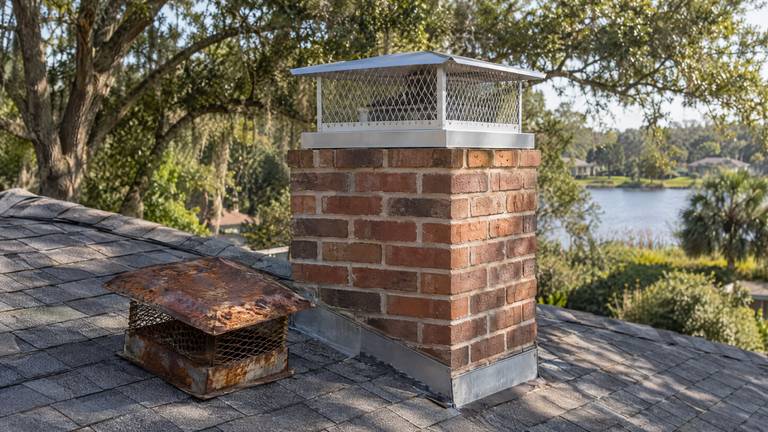
Set a lid too close to the tile and the flue is choked. For a rain cap on a masonry chimney, the Florida Building Code wants the open area beneath the lid to be at least four times the flue outlet's own open area, and spark arrestors carry the same four-to-one ratio.
We check that ratio for the cap and flue in front of us, especially on caps made to order or adjusted in the field. A generous opening lets the exhaust leave while the lid still turns rain away from the tile.
An unused fireplace still needs a cap
A fireplace nobody lights can still take in rain and animals. Water that runs down an open flue rusts the damper, stains the firebox and soaks the smoke chamber, however long it has been since the last fire.
Capping an idle chimney is one of the simplest ways to keep it from deteriorating. If you plan to use the fireplace again one day, we fit a cap that can be removed for sweeping and inspection when that day comes.
A cap with a top-sealing damper
Some caps are combined with a damper that seals the top of the flue. A cable runs down to the fireplace, and pulling it opens or closes the lid. When it is closed, rain, animals and outside air stay out of the chimney.
A top-sealing damper suits some chimneys better than others, and it has to be fully open whenever the fireplace is in use. We explain whether your flue can take one and how it compares with a standard cap before you decide.
Metal chimneys that run through a chase
A factory-built chimney often rises through a framed box called a chase. The pipe ends in its own termination cap, and a metal chase cover closes the top of the box around it. The two parts are separate and wear out separately.
A rusted chase cover can leak even under a new cap, and a failed cap can let rain into a sound chase. We check both at the free inspection and price each one on its own line, so you know which part the work is replacing.


