
Chimney Services
Liner installation details for Heathrow homes
The route, the insulation and both connections are settled before a liner is ordered.
When a liner needs insulation
Under UL 1777, insulation is required when the chimney does not meet the construction standard for its walls and clearances. One maker also notes that insulation helps the draft, keeps exhaust warmer and reduces condensation.
Insulation is part of the listed system, never an optional extra to drop when space is tight. We explain whether your chimney needs it and include the insulation, its fitting and its effect on liner size in the estimate. Where the passage is too tight for an insulated liner of the required size, we explain the alternatives rather than leaving the insulation out.
Proving the route before ordering
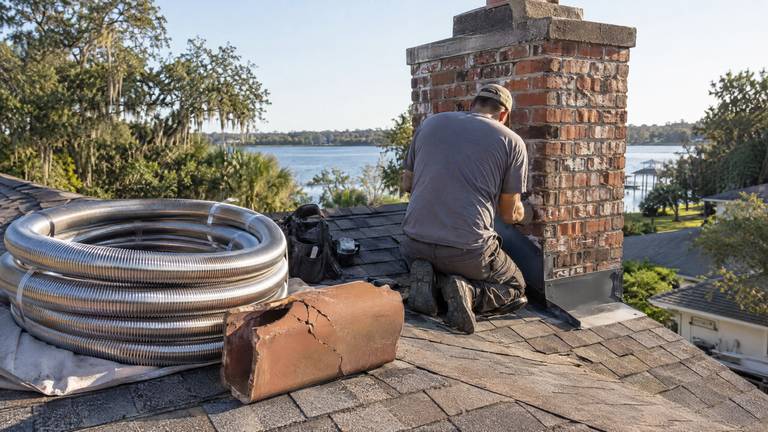
Before a liner is ordered, the route is tested with a short piece of liner or a guide cone pulled through the flue. That shows whether the chosen size, with any insulation, can pass the whole way.
A liner forced through a tight spot can be crushed or torn, and that damage may not be visible from either end. Proving the route first keeps the installation day predictable and the price accurate. If the test piece will not pass, we know before the liner is ordered, and the plan can change without waste.
A cap on top of the new liner
The listed system ends in a cap that keeps rain, debris and animals out of the liner. Where a spark arrestor screen is used on a masonry chimney, the building code sets how fine the mesh may be and requires it to be removable for cleaning.
We fit the cap that belongs to the listed system and fasten it to hold in wind. Its type and material are written in the estimate with the rest of the liner parts. A cap from outside the system is avoided, since it may not fit the liner or carry the same listing.
Building permits and local officials
One liner maker's instructions note that permits may be required and that local building and fire officials have the final say on an installation. Requirements depend on the project and the jurisdiction.
If we expect a permit question to arise, you hear it early, and we never present the job as exempt without checking. Any permit step is part of the plan we explain before the work is scheduled. Any conditions an official sets become part of the plan, and the schedule allows for them.


