
Our Services
Crown repair details that matter
You learn what a coating can fix, and what only a rebuild can, before any work starts.
An overhang with a drip edge
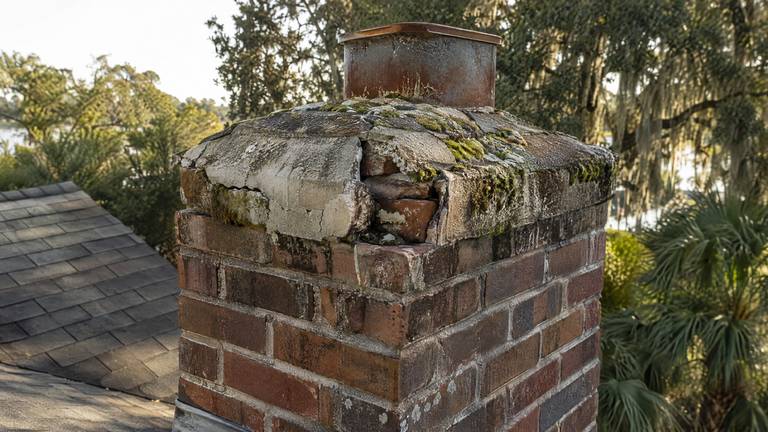
Water that runs off the crown should fall clear of the brick instead of running down the face. A crown that projects past the brick with a groove or edge underneath, called a drip, breaks the path of the water so it drops away.
Masonry chimney tops need a drip edge under the Florida Building Code. Where a crown has no overhang, the Brick Industry Association suggests corbeling the top two courses of brick outward to form one. When we rebuild a crown, the overhang and drip are formed into it from the start.
A bond break around each flue
Clay or metal liners and the concrete around them expand and shrink by different amounts as they heat and cool. Lock the two together and the crown splits from the flue outward. It is why the state building code specifies a caulked break, per ASTM C1283, between the crown and every liner it surrounds.
On a crown we rebuild, each liner gets a separation and a flexible sealant joint so the two can move without damaging each other. On a crown we keep, we check the joint at each flue and reseal it when the old sealant has hardened or pulled away.
Sun, heat and crown movement
A crown sits in full sun and heats and cools every day. Concrete, brick and the clay or metal liner all move by different amounts, and that repeated movement opens small cracks and pulls sealant away from the flues over time.
That is why a well-built crown includes bond breaks, flexible joints and reinforcement. When we repair a crown, we keep those details in place so the next few summers do not undo the work. It is also why rigid patches that cannot move with the crown tend to crack again along the same line.
Crowns on chimneys with several flues
A chimney that carries two or three flues needs a crown shaped around all of them, with slope running away from each liner and enough width between them for a sound surface. Narrow strips of concrete between flues crack easily.
The form is planned around the actual flue layout, with a bond break at every liner and room for a cap that may cover some or all of the flues. The estimate shows the crown work and any cap work separately.


