
Our Services
How we install chimney liners in Gabriella
The relining plan is explained on site, and a same-day inspection in Gabriella is possible when the schedule allows.
Listed liner systems
Metal chimney liner systems are tested and listed to UL 1777, the safety standard for chimney liners. A listed system is a set of parts, including the liner, its connectors, the top plate and the cap, tested to work together.
We install listed systems according to their instructions and do not mix parts from different makers. The system details are written into the estimate and left with you after installation, so any future work can follow the same listing. Keeping the listing intact also matters when a part needs replacing later, since a substitute from another system may not carry the same listing.
One path for each appliance
The arrangement of a liner depends on the type, number and location of the appliances using the chimney, as one maker's instructions state. Two appliances are not joined into one liner unless their instructions and the code allow it.
We identify every appliance connected to the chimney before planning, including any that are rarely used. Each one gets a venting plan that suits its instructions, written into the estimate. Where the chimney holds only one usable flue for two appliances, we explain what each maker allows and which options remain.
Old tiles in the way of a new liner
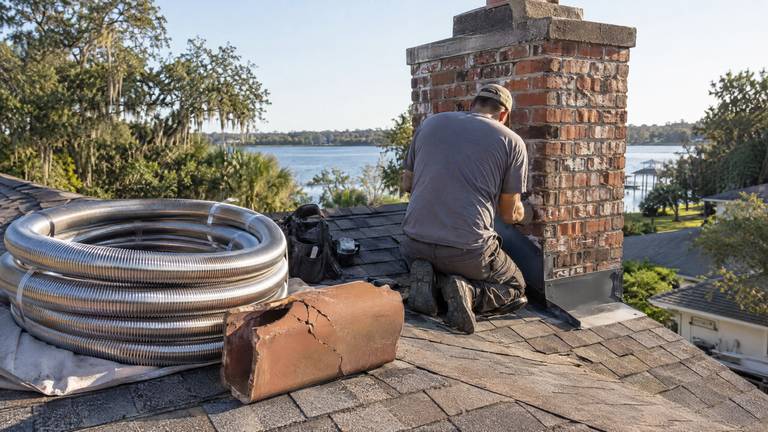
Damaged clay tile that blocks the route may need to be broken out so the new liner can pass. One maker describes chipping damaged tile flush and keeping the broken pieces out of the flue, while sound tile that only protrudes may stay.
We explain in advance whether tile removal is expected, how debris will be collected and how the room will be protected. Tile removal appears in the estimate when the route test shows it is needed. Only the tile that has to go is removed, and sound tile left in place keeps its role around the new liner.
Joining two liner lengths
When a single length cannot cover the run, two lengths can be joined with a connector made for the system. The joint has to follow the maker's instructions to stay sealed and secure inside the flue.
We avoid unnecessary joints and place any required joint where it will be sound. The joining parts come from the same listed system as the liner, never from a different maker. Where a joint is needed, its location is noted in the system details you keep.


