
Our Services
Planning a new chimney liner
Local specialists and upfront prices on every relining in Alderene Park, backed by our 100% satisfaction guarantee.
A cap on top of the new liner
The listed system ends in a cap that keeps rain, debris and animals out of the liner. Where a spark arrestor screen is used on a masonry chimney, the building code sets how fine the mesh may be and requires it to be removable for cleaning.
We fit the cap that belongs to the listed system and fasten it to hold in wind. Its type and material are written in the estimate with the rest of the liner parts. A cap from outside the system is avoided, since it may not fit the liner or carry the same listing.
When an appliance leaves the chimney
Removing a furnace or water heater from a shared flue can leave the remaining appliance venting into a passage sized for more exhaust than it produces. Under NFPA 211, adding, removing or replacing a connected appliance is one of the moments that call for a closer examination.
We check whether the remaining flue still suits the appliance that uses it. If it is now too large, a liner sized for that appliance is one solution, and we explain it alongside any other option the appliance maker allows. This can happen after a furnace is replaced with a unit that vents another way, leaving the water heater on its own in the old flue.
Joining two liner lengths
When a single length cannot cover the run, two lengths can be joined with a connector made for the system. The joint has to follow the maker's instructions to stay sealed and secure inside the flue.
We avoid unnecessary joints and place any required joint where it will be sound. The joining parts come from the same listed system as the liner, never from a different maker. Where a joint is needed, its location is noted in the system details you keep.
How insulation is fitted
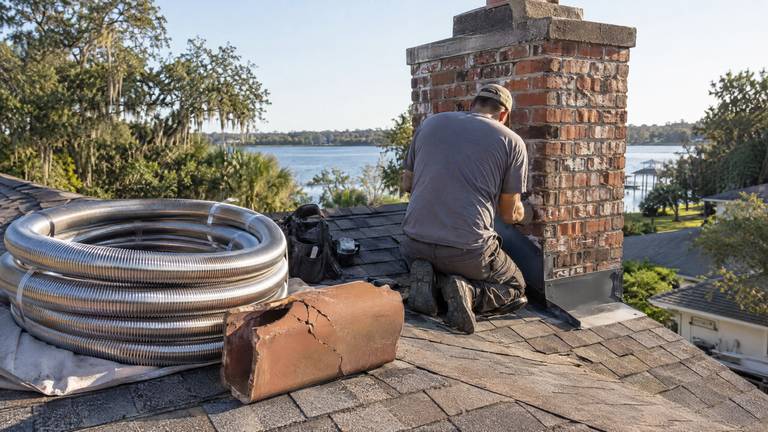
Insulation wrap is fitted around the liner before it goes into the flue. One maker's instructions describe a foil-faced blanket held with stainless steel mesh, stopped short of the crown so the liner can expand as it heats.
Fitted this way, the insulation stays in place during the pull and once installed. We check that the wrapped liner still passes the route test before the final installation. Insulation that bunches or slips during the pull can leave gaps, so the wrap is secured along its full length.


