
Chimney Services
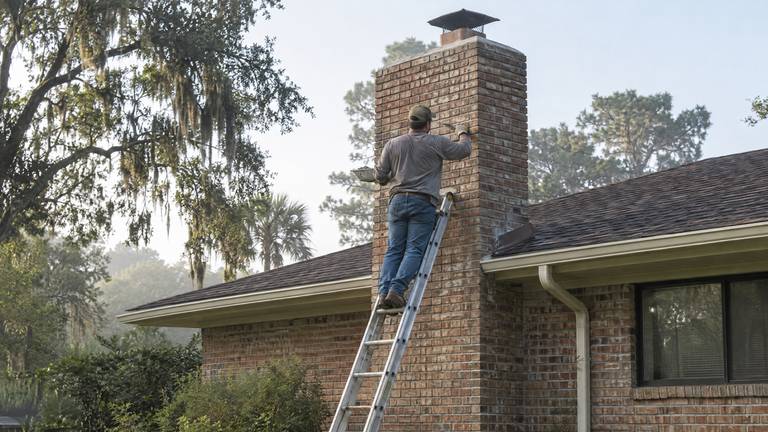
Inside a tuckpointing job in Wagner
Cutting out mortar without chipping the brick
Grinders are fast, but they are hard to control in narrow joints. Preservation Brief 2 warns that power saws on thin brick joints break the brick edges and overcut the head joints, and Technical Note 46 notes that a grinder cannot clear the full depth of a head joint without damaging the brick beside it.
On a careful job, the short vertical joints are therefore finished with a chisel. Our crew uses power tools only where they can be controlled and switches to hand tools at the head joints and around soft or rounded brick. The edges of your brick stay intact, and the new joints keep their original width.
Letting new mortar joints weather in
Even a well-matched repair looks newer than the joints around it for a while. The Park Service brief explains that new mortar is matched to the unweathered portion of the old, and that sand shows more on old joints as their surface erodes. Its advice for a properly matched mortar is to let it age naturally.
The same brief generally advises against staining new mortar to force a match, because old and new joints may weather at different rates. We tell you what to expect in the first months, so the fresh look of a new repair on your Wagner chimney is not mistaken for a mismatch.
Cleaning brick after repointing
New joints stay vulnerable for a while after they look finished. The Park Service brief says fresh mortar does not fully cure for several months, that it should be fully hardened before a repointed wall is cleaned, usually after about thirty days, and that metal bristle brushes should not be used on historic masonry.
We brush excess mortar off the brick as the joints are tooled, so a separate cleaning step is rarely needed afterwards. If other cleaning is planned for the chimney, tell us, and we will schedule it so the new joints are not harmed.
Softer mortar for older brick
Early masonry mortars were mostly lime, with little or no portland cement, and had lower strength. Technical Note 8B concludes that repairing older masonry will likely call for a weaker mortar than new construction, noting that Type O is often used to repoint older brickwork while Type N may suit newer brickwork.
The principle holds at any age. The new joint should be the part that gives, rather than the brick. Our specialists match the mix to your chimney's brick and existing mortar, whatever year it was built, and explain the choice before work begins.


