
Our Services
Getting a rebuilt chimney right in Slavia
How we plan a rebuild on your Slavia chimney, from the first sound course to the new cap.
Finding where sound masonry begins
A rebuild starts by deciding how far down the chimney has to come. Our masons take courses off from the top and check each one as it comes away, looking for mortar that still grips and brick that is still solid. The new work begins on the first course that is firmly bedded and square.
That point is often at or just below the roofline, but it depends entirely on the chimney. Stopping too high leaves weak masonry under new brick, and taking down more than needed adds cost for nothing. Your estimate names the expected stopping point and explains what would change it once the old brick is off.
If the brick at the planned stopping point turns out weaker than expected, we stop, show you the course in question and agree the new stopping point and price with you before continuing.
A new crown on the rebuilt top
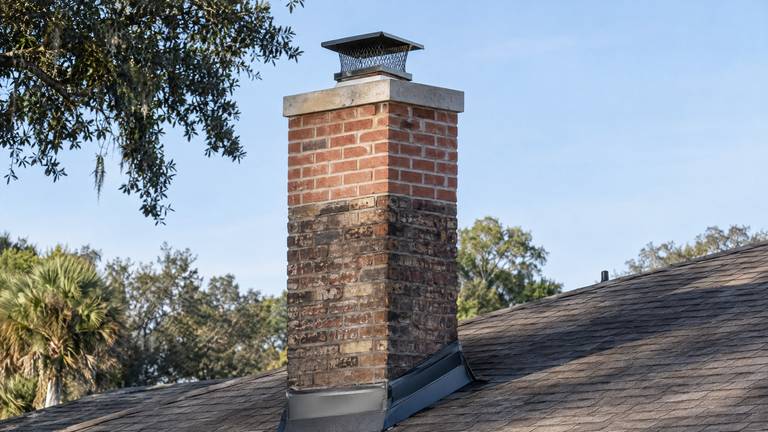
Every rebuilt masonry chimney gets a new cap on top, usually called the crown. The code lists four things for that cap in section R1003.9.1: concrete, metal or stone as the material, a slope for runoff, a drip edge, and a bond break sealed with caulk wherever a flue liner comes through.
The slope keeps rain from pooling, the drip edge throws water clear of the brick below, and the bond break lets the liner and crown move separately as they heat and cool. A thin mortar wash troweled over the top course does none of that well, so we form and cast a proper crown on every rebuild and list it on the estimate.
We also make sure the crown overhangs the brick far enough for the drip edge to work, and we seal the joint around the flue liner with a flexible sealant instead of hard mortar.
When the problem starts at the footing
A chimney that leans, pulls away from the house or cracks from the ground up may be telling you about its footing. Florida's residential code sets the footing under a chimney at 12 inches thick or more, in concrete or solid masonry, projecting at least 6 inches past the chimney on every side.
Rebuilding the top of a chimney that is still settling at the bottom only moves the problem upward. When the signs point below grade, we say so before quoting a rebuild and recommend that a structural engineer look at the footing first. That advice can change the whole plan, and it is better heard at the start.
Signs we look for include cracks that widen toward the ground, a chimney base that has dropped relative to the house foundation and gaps that are wider at the top than at the bottom.


