
Our Services
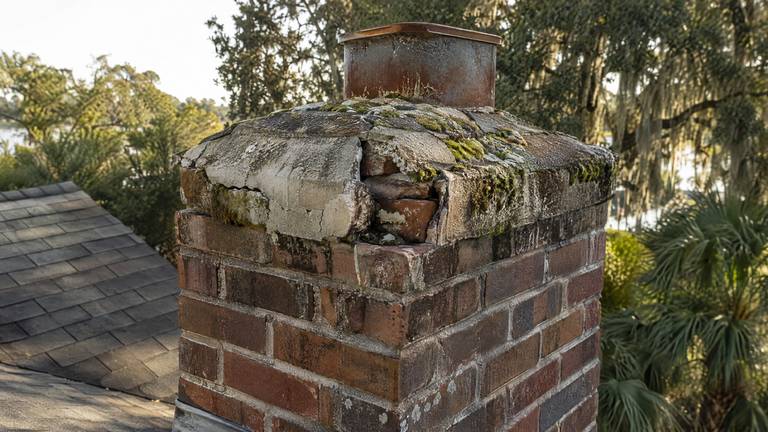
The chimney crown, repaired from the top down
The inspection costs nothing, and you choose between sealing and rebuilding with both options priced.
Precast and cast-in-place crowns
A crown can be cast on the chimney or made in advance and set on a mortar bed. The Brick Industry Association says prefabricated caps generally perform better than cast-in-place ones and are more easily made water-resistant, and it recommends that a cast-in-place crown follow the same shape, with thickened sides and an overhang.
Both can be done well. The choice depends on the chimney's size and shape, access to the roof and how the flues are arranged. We explain which approach fits your chimney and price it in writing before any work starts.
Coating over an older coating
Crowns that have been treated before may carry a layer of old sealer, paint or patching compound. Some of it still grips well and some of it is peeling, and a new product cannot grip a surface that is coming loose.
We test how the old layer is holding, remove what is failing and clean the surface before anything new goes on. If the old material is unknown and the product maker calls for bare masonry, we strip it. You see that preparation listed on the estimate.
White deposits on the upper brick
White, powdery staining near the top of a chimney is efflorescence. The Brick Industry Association explains that it forms when water carrying dissolved minerals reaches the surface of the masonry and evaporates, leaving the minerals behind. It is a sign of water traveling through the brick.
Washing the deposits off treats the symptom. We look above them for the source, which is often a cracked crown, an open joint at the flue or missing sealant, and we fix the water path before cleaning the face.
Crowns on chimneys with several flues
A chimney that carries two or three flues needs a crown shaped around all of them, with slope running away from each liner and enough width between them for a sound surface. Narrow strips of concrete between flues crack easily.
The form is planned around the actual flue layout, with a bond break at every liner and room for a cap that may cover some or all of the flues. The estimate shows the crown work and any cap work separately.


