
Our Process
How chimney joints are repointed in Sanlando Springs
Cutting out mortar without chipping the brick
Grinders are fast, but they are hard to control in narrow joints. Preservation Brief 2 warns that power saws on thin brick joints break the brick edges and overcut the head joints, and Technical Note 46 notes that a grinder cannot clear the full depth of a head joint without damaging the brick beside it.
On a careful job, the short vertical joints are therefore finished with a chisel. Our crew uses power tools only where they can be controlled and switches to hand tools at the head joints and around soft or rounded brick. The edges of your brick stay intact, and the new joints keep their original width.
Matching the original chimney mortar
For the best match, the Brick Industry Association recommends duplicating the original mortar's ingredients and proportions, and where the type is unknown, sending samples to a testing laboratory. ASTM C1324 is the test method generally used to examine hardened mortar and estimate its proportions.
Most homeowners do not need a laboratory report to repoint a chimney. Where the brick is old, soft or unusual, though, an analysis can be the safer route, and we will say so and explain how it affects the schedule. Either way, the mortar decision is made before the first joint is cut.
Prehydrating the repointing mortar
Repointing mortar is mixed differently from the mortar used to lay brick. The dry ingredients are combined first, then just enough water is added for the mix to hold its shape when squeezed into a ball. After it rests for 1 to 1 1/2 hours, more water brings it to a consistency that is still drier than laying mortar.
Technical Notes 8B and 46 both describe this prehydration step, and the reason is shrinkage. A drier, rested mortar packs tightly into the joint and shrinks less as it sets, which means fewer hairline gaps along the brick edges. It adds time to the job, and it belongs in the job.
Your roof and yard during the work
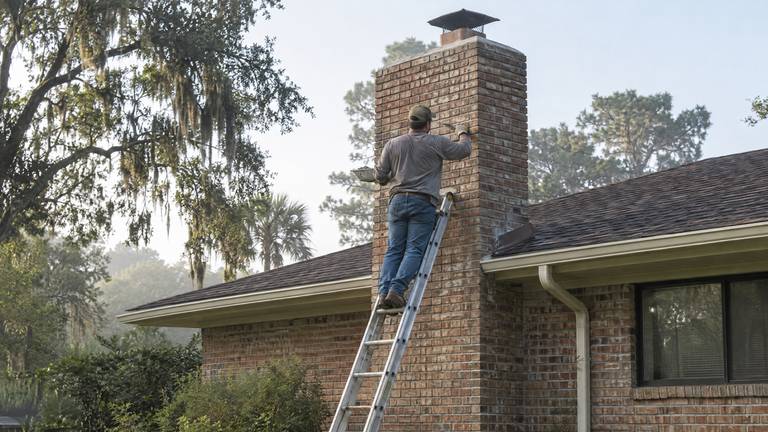
Cutting out mortar creates dust and a steady fall of grit. Before work starts, the roof around the chimney, the gutters, plantings and anything stored below are covered or moved, and windows near the chimney are kept closed while joints are cut.
When you book, mention any fragile roof coverings, solar panels, an air conditioning unit or a pool area near the chimney. Our family-owned crew plans access and protection around them, and the site is cleaned before we leave. Keep children and pets clear of the area below the chimney while we work.


