
Our Process
How chimney joints are repointed in Longwood
Why shallow repointing fails early
The Park Service brief ties its depth rule to two goals, an adequate bond and the prevention of mortar popouts. New mortar needs enough contact with sound surfaces inside the joint to stay put through years of rain and heat. Filling only the top of a joint gives it very little to grip.
Popped-out mortar is easy to spot later as short strips missing from otherwise new joints. If an earlier repair on your chimney has failed that way, our specialists cut it back and redo the joint properly, and the free inspection tells you how much of the old work has to come out.
Chimney mortar types under ASTM C270
ASTM C270, the standard specification for mortar for unit masonry, sorts mortar into Types M, S, N and O. The Brick Industry Association describes Type N as a general all-purpose mortar, Type S as a stronger all-purpose mortar and Type O as a low-strength mortar used mostly for interior work and restoration.
For chimney brickwork, BIA Technical Note 19B recommends Type N portland cement-lime mortar and accepts Type S where higher lateral loads call for it. Repointing adds the compatibility rule on top of that, so an older chimney may take a softer type than new construction would. We explain the choice for your chimney in plain terms.
Hairline mortar cracks and face grouting
For very fine cracks in otherwise sound joints, Technical Note 46 describes face grouting, where a thin grout of cement, lime and fine sand is brushed into the cracks, usually in two coats. The note warns that the joints look slightly wider and smoother afterwards, and says repointing is generally recommended because it corrects more kinds of deterioration.
We mention face grouting when a chimney genuinely fits it and explain the change in appearance before you decide. Where the mortar is soft, recessed or hollow, grouting will not hold, and repointing is the repair we quote.
The brick courses just below the crown
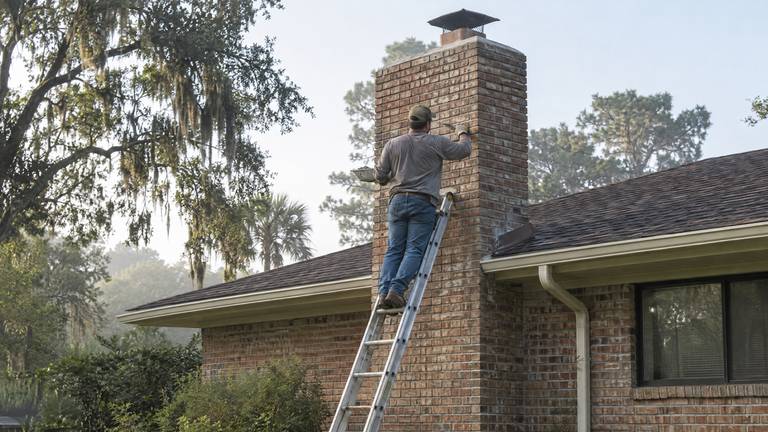
The top courses of a chimney stand in the open on every side, and any water that gets past the crown runs straight down into them. The crown and cap sit on this part of the brickwork, so loose joints here are worth repairing before they spread.
Our crew repoints the upper courses with the crown and cap in view. If the crown is cracked or the cap is letting water in, new joints below it will be soaked again, so those findings are priced as separate repairs next to the joint work.


