
Services
How we rebuild chimneys in Longwood
The Florida Building Code and brick industry guidance, applied to rebuilds in Longwood.
Rebuilding the part above the roof
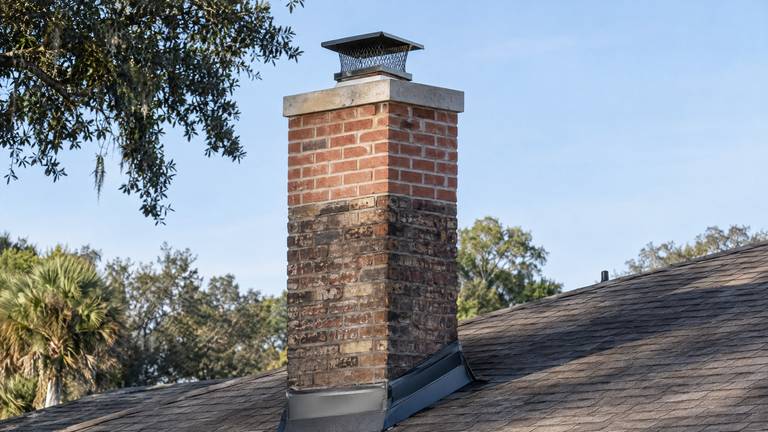
The section of chimney above the roof takes weather from every side and is usually the first part to need rebuilding. Loose top courses, cracked crowns and flashing that no longer seals tend to show up together on that exposed stretch.
Rebuilding above the roofline means taking that section down to sound masonry, relaying it with new brick and mortar, casting a new crown and tying the roof flashing back into the fresh joints. The roof around the chimney is protected throughout, and each part of the work is listed on its own line so you can see what the price covers.
Because the roof is already open around the chimney, this is also the natural moment to check the decking and underlayment beside it, and we tell you if any of it looks soft or stained.
Keeping wood framing away from the masonry
Masonry chimneys need a gap between the brick and any combustible framing. The Florida Building Code, Residential, calls for an airspace of 2 inches or more when the chimney sits inside the house or within an exterior wall, and 1 inch or more when it stands entirely outside, including where it passes a soffit or cornice.
Where the chimney passes floors and ceilings, that space is closed with noncombustible fireblocking. A rebuild that reaches the attic or the roof framing restores those gaps and firestops, and anything we find touching the masonry is written up before the new brick goes in.
A rebuild is also a chance to find wood that was built too close years ago, such as blocking or a rafter resting against the brick, and we plan the correction with you.
A cap sized to the rebuilt flue
A rebuilt chimney is finished with a cap to keep out rain, animals and sparks. The Florida Building Code, Residential, requires a spark arrestor on a masonry chimney whose net free area is no less than four times the flue outlet's area, screen openings between 3/8 and 1/2 inch, and a screen or cap that comes off for cleaning.
A cap that is too small can choke the draft of a freshly rebuilt chimney, and one fixed in place makes every future cleaning harder. We size the cap to the finished flue and include it on the estimate as its own line.
The cap is fastened to the crown or the flue in a way that lets it come off for cleaning, and we show you how it attaches so future service is straightforward.


