
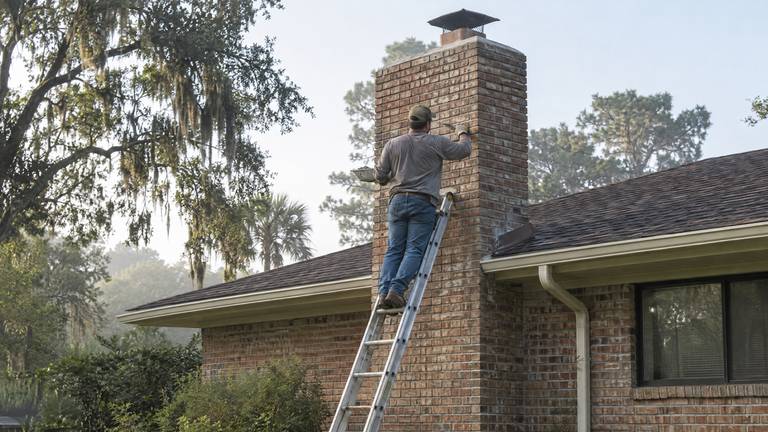
Chimney Services
Inside a tuckpointing job in Heathrow
Chimney mortar types under ASTM C270
ASTM C270, the standard specification for mortar for unit masonry, sorts mortar into Types M, S, N and O. The Brick Industry Association describes Type N as a general all-purpose mortar, Type S as a stronger all-purpose mortar and Type O as a low-strength mortar used mostly for interior work and restoration.
For chimney brickwork, BIA Technical Note 19B recommends Type N portland cement-lime mortar and accepts Type S where higher lateral loads call for it. Repointing adds the compatibility rule on top of that, so an older chimney may take a softer type than new construction would. We explain the choice for your chimney in plain terms.
Letting new mortar joints weather in
Even a well-matched repair looks newer than the joints around it for a while. The Park Service brief explains that new mortar is matched to the unweathered portion of the old, and that sand shows more on old joints as their surface erodes. Its advice for a properly matched mortar is to let it age naturally.
The same brief generally advises against staining new mortar to force a match, because old and new joints may weather at different rates. We tell you what to expect in the first months, so the fresh look of a new repair on your Heathrow chimney is not mistaken for a mismatch.
Repointing before a water repellent
Clear-coating guidance from the Brick Industry Association lists repointing of incompletely filled, cracked or disintegrated joints among the repairs to finish before any water repellent is applied, because a coating cannot seal an open joint. The data sheet for one chimney water repellent asks for at least 72 hours after repairs or tuckpointing before application.
If you plan to waterproof your Heathrow chimney, repointing comes first in the schedule, and the two jobs are priced as separate lines. The same BIA guidance notes that repairs often correct a moisture problem on their own, so we are glad to wait and see before treating the brick.
Plant growth rooted in chimney joints
Some plant growth carries moisture into voids in the mortar, according to Brick Industry Association maintenance guidance, which advises cutting vines carefully away from the wall instead of pulling them, which can damage the brickwork, and letting the embedded shoots dry before brushing them off.
A seedling rooted in a joint high on a chimney usually means the mortar there is soft and holding water. We remove the growth, rake the joint back to sound mortar and repoint it, and we check the joints around it that have been kept damp.


