
Chimney Services
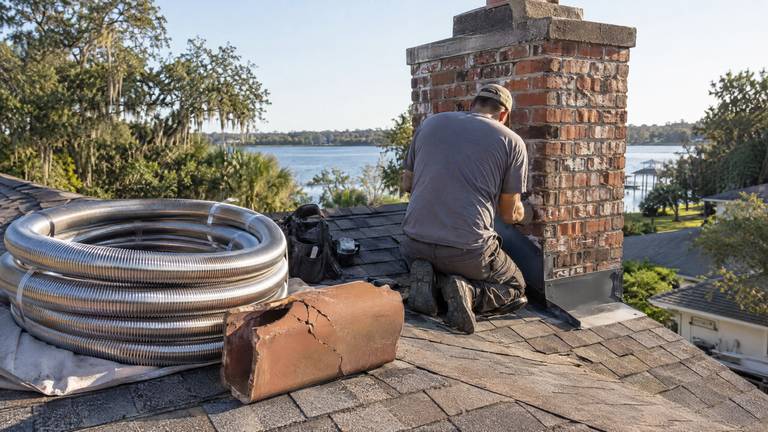
Relining the chimney from top to bottom
Every liner is sized to the appliance it serves, and the full system is priced in writing first.
Sizing the liner to the appliance
A flue smaller than the connector it serves is not allowed under the Florida Building Code. One liner maker also warns against a liner far larger than the appliance outlet, since oversizing slows the exhaust and lets it cool.
We size the liner from the appliance outlet and its instructions, then check that the chosen size fits the passage with any required insulation. The sizing basis is written in the estimate, so the choice can be checked against the appliance manual. When the passage is too small for the required size with its insulation, we explain the options instead of fitting a smaller liner than the appliance calls for.
Flue size for an open fireplace
An open masonry fireplace needs a flue area in proportion to its opening. The Florida Building Code sets that proportion at one-twelfth of the opening for a round flue, one-tenth for a square flue and one-eighth for a rectangular flue whose sides differ by a ratio of 2 to 1 or more.
A liner too small for the opening can leave smoke spilling from the front of the fireplace even when everything else is sound. We measure the opening and the flue before recommending a liner for an open fireplace. When the existing passage cannot hold a liner of the required area, we explain what that means for an open fireplace and what the alternatives are.
Structural repairs come first
A liner does not hold a chimney together. Missing, loose or cracked masonry and open joints need repair before a liner is installed, as one maker's instructions state.
While the liner is being planned, the chimney structure is inspected, and you learn which repairs have to come first. Each repair is priced separately, so you can see the relining cost and the masonry cost on their own lines and plan them in the right order. Relining over a structural problem would leave the new system inside a chimney that still needs work, and the liner might have to come out again when that work is done.
Measuring the liner length
The liner has to reach from the appliance connection to the top of the chimney with a little extra for trimming. One maker's instructions measure from the bottom of the opening to the top and add about six inches.
We measure on site rather than estimating from the outside, since offsets and the connection point change the length. An accurate length keeps extra joints out of the flue and keeps the price stable. The measured length is written in the estimate next to the liner size.


