
What's Included
Chimney flashing repair in Geneva, detail by detail
Sealant that belongs in a flashing joint
Sealant has a real place in a flashing detail, at the reglet and at laps, but the type matters. The Brick Industry Association recommends a good grade of polysulfide, butyl or silicone rubber sealant in chimney joints, never an oil-based one, with proper priming and backing.
We use sealant where the detail calls for it and rely on metal everywhere else. Our local team explains the difference on site in Geneva, and the written price comes before any work, with no hidden fees.
Testing one side at a time
When the source is not obvious, a controlled water test helps. Water is run onto one area at a time, starting low on the chimney and working up, while someone watches inside. When the leak appears, the last area wetted points to the entry, and the flashing on that side gets a closer look.
We only water test when it will answer a question, and we explain the plan first. Our local team starts with a free inspection in Geneva, and a 10% discount follows for any service you book in the next 72 hours.
Flashing on a stucco-finished chimney
Many chimneys are finished in stucco rather than bare brick. The counter flashing cannot simply be let into a brick joint, so the detail depends on what sits behind the finish and how the stucco ends above the roof. A crack where the stucco meets the flashing is a common entry point for water.
The finish, the flashing and the line where they meet all get checked, and we tell you whether stucco chimney repair belongs in the same job. Both can be scheduled together for your Geneva home.
After a storm lifts the flashing
During the Atlantic hurricane season, from June 1 to November 30, strong wind can lift the edge of an apron or peel counter flashing out of its joint. Wind-driven rain then gets in where ordinary rain would not. After a storm, a new stain near the chimney deserves a prompt look.
Our local team checks storm-lifted flashing and tells you whether a repair or a full reflash is needed. For wider damage, our storm damage chimney repair service covers the rest. The inspection in Geneva is free.
What a full reflash involves
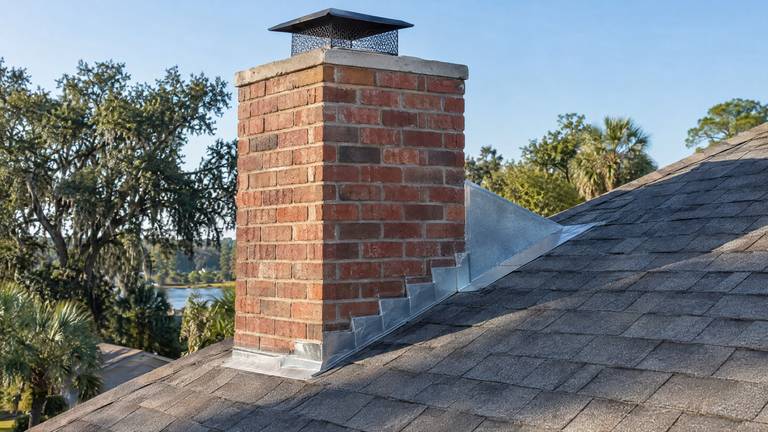
A full chimney reflash usually means lifting the roofing around the chimney, removing the old apron, steps, back flashing and counter flashing, cleaning and cutting the reglet, then installing new base flashing, steps and counter flashing in order before the roofing goes back down.
Every step and its price is on the written estimate before we begin. Book with our local team within 72 hours of your Geneva inspection and 10% comes off, with our 100% satisfaction guarantee on the finished flashing.


