
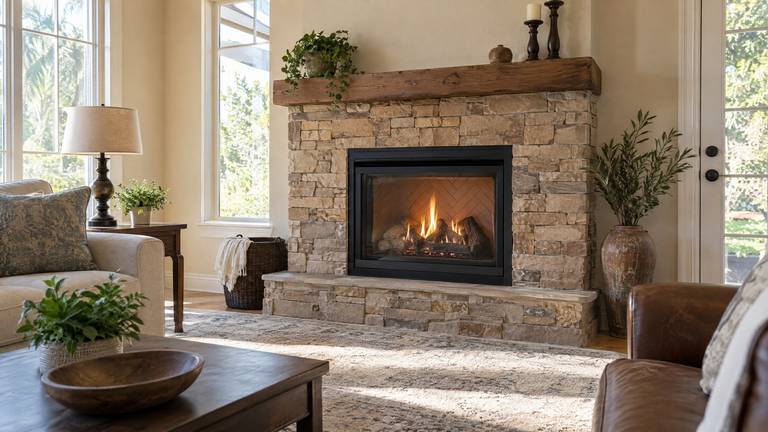
Gas Fireplace
From firebox check to first flame
Gas log installation from local technicians who follow the manual to the last ember.
Factory-built fireplaces need a listing check
Metal factory-built fireplaces follow their own listing. Florida's residential code keeps unvented gas log heaters out of factory-built fireplaces unless the fireplace system itself has been tested, listed and labeled for one. The fireplace's own manual often names the gas appliances it accepts.
The fireplace label and its manual are read before any set is quoted for a factory-built unit. If the listing does not allow the set you want, we explain what it does allow. Identifying the fireplace also tells us which damper, screen and doors it came with, and whether a vented set would change how any of them are used. Nothing is ordered until that check is done.
Supply pressure the burner needs
Every burner lists a minimum and a maximum inlet pressure, and the figures differ between natural gas and propane. One maker warns that low pressure keeps the oxygen depletion sensor pilot on its vent-free set from working properly, and that the piping has to be sized for the burner's full flow, with long runs needing a larger line.
We check the supply with a gauge where a test point allows and compare it with the manual. If the piping is too small or the pressure too low, that correction goes to a gas contractor, and we note it in the quote before any set is ordered. Pressure readings are noted in the written record, so the next technician starts from a known figure.
Vent-free logs need someone in the room
One maker's manual calls its vent-free set an attended appliance. Adults must be present while it burns, and it must never be left burning when nobody is in the room or while anyone is sleeping. Young children should be supervised near it.
Those rules come with the set, and they matter when deciding between vented and vent-free. If the fireplace is somewhere you would like to leave burning for long stretches, we talk through whether a different appliance suits you better. The written quote notes which kind of set is proposed, so the rules that come with it are clear from the start.
Carbon monoxide and a gas log set
Any gas fire can make carbon monoxide if it burns badly, and the gas has no color or smell. The U.S. Consumer Product Safety Commission advises carbon monoxide alarms that run on batteries or have battery backup, placed on each floor of the home and outside the bedrooms. A set that is installed and serviced correctly burns cleanly, and an alarm is the backstop if something changes.
If an alarm goes off, everyone goes outside, and the call to 911 is made from there. One maker's manual also lists headache, dizziness and nausea as early signs and says to get fresh air and stop using the appliance at once.


