
Our Services
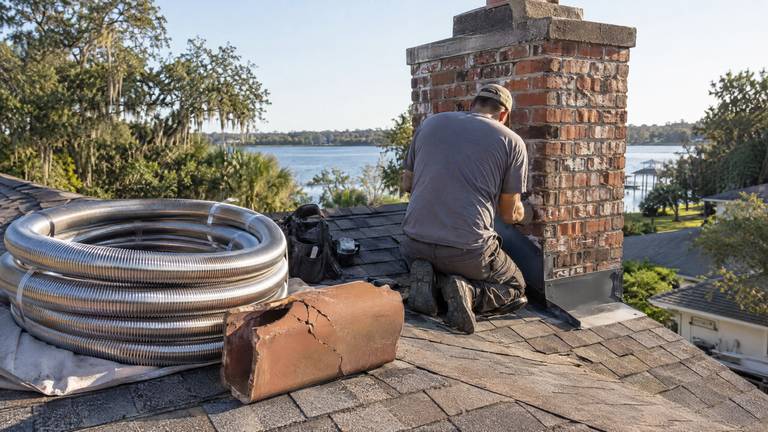
Planning a new chimney liner
Listed liner systems installed across Forest City, starting with a free inspection from our family-owned team.
When the flue is too large
An oversized flue gives exhaust more room than it needs, so it moves slowly and cools on the way up. One liner maker's instructions link incorrect sizing to condensation, creosote build-up and poor draft.
Relining with a liner sized to the appliance restores a passage in proportion to the exhaust. We explain the current flue size, the size the appliance calls for and the difference a new liner would make before you decide. For a gas appliance, the same mismatch tends to show up as moisture, so the liner size is checked against the appliance instructions rather than the old flue.
When an appliance leaves the chimney
Removing a furnace or water heater from a shared flue can leave the remaining appliance venting into a passage sized for more exhaust than it produces. Under NFPA 211, adding, removing or replacing a connected appliance is one of the moments that call for a closer examination.
We check whether the remaining flue still suits the appliance that uses it. If it is now too large, a liner sized for that appliance is one solution, and we explain it alongside any other option the appliance maker allows. This can happen after a furnace is replaced with a unit that vents another way, leaving the water heater on its own in the old flue.
Crown repairs before the top plate
Cracks in the crown are to be repaired before the liner is installed, according to one liner maker's instructions. The top plate and cap need a sound surface to seal against.
When the crown needs more than crack repair, we explain whether it should be rebuilt before relining. The crown work is priced on its own line, so you can see it next to the liner system and decide with both in view. A new top plate set on a failing crown would leave the new liner exposed to the same water the crown lets in.
Airspace around an interior chimney
The building code keeps masonry chimneys separated from combustible framing by an airspace, which is larger for a chimney inside the house than for one built entirely outside it. That space protects the framing from heat passing through the masonry.
When the airspace is missing or cannot be confirmed, the liner plan changes, often to an insulated system. We explain what we could see in the attic or crawl space and how the plan responds to it. Where framing touches the masonry, the finding explains why that matters for the liner plan and what a correction would involve.


