
Chimney Services
Before your chimney is rebuilt in Elder Springs
Three things our masons in Elder Springs explain before any brick comes down.
Setting the flue lining in a rebuilt section
When a clay-lined chimney is rebuilt, the flue tiles in that section are reset or replaced along with the brick. The Florida Building Code, Residential, calls for clay liners installed to ASTM C1283, laid in medium-duty, water-insoluble refractory mortar with smooth, tight joints.
The code also keeps a clay flue within 30 degrees of vertical, requires the liner to be supported on all sides and keeps a narrow air space or insulation between the liner and the brick around it. We explain how your liner will be handled before the old section comes down, so the new masonry is built around a sound flue.
If tiles in the section that stays are cracked or out of line, we tell you before rebuilding over them, since a sound new top on a damaged flue leaves the real problem hidden below.
Clay tile or a listed metal liner
A rebuild opens a decision about the flue. Reset clay tile suits many masonry fireplaces, while a lining system listed to UL 1777, such as a stainless liner, is another option the Florida Building Code, Residential, accepts.
The right choice depends on what burns below, the size and shape of the flue and how much of the old lining is sound. We explain the options for your chimney and price them separately, so the masonry rebuild and the lining decision can each be judged on their own. If the fireplace or stove is changing too, tell us early, since the liner has to suit the appliance it serves.
Whichever lining you choose, it is carried up through the rebuilt courses and finished at the top so the crown, the liner and the cap work together as one detail.
Tying the roof flashing into the new brick
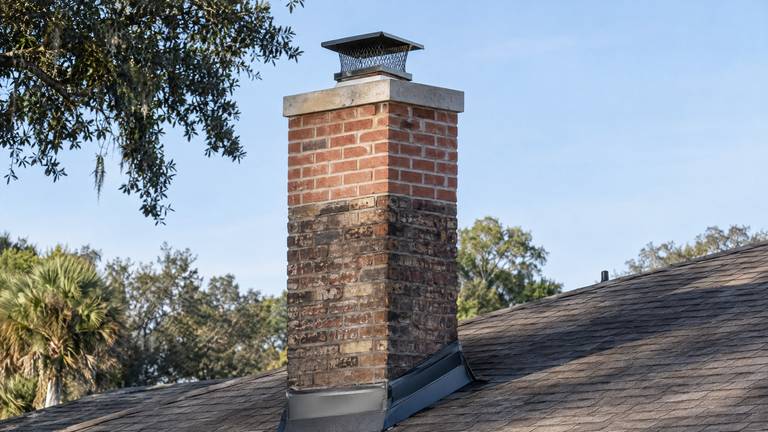
The flashing where a chimney meets the roof has two layers: base or step flashing woven into the roofing, and counterflashing let into the masonry and turned down over it. On a rebuild, the slot for the counterflashing is built into the fresh joints.
Rebuilding and reflashing therefore belong in one plan. New brick with old, reused flashing leaves the weakest joint in the wrong place, and fresh flashing cut into a chimney that is about to come down is wasted money. We schedule the two together and agree with your roofer, if you have one, on who finishes each layer.
Sealant alone along the top edge of flashing is a short-term fix. On a rebuilt chimney the counterflashing sits in a mortar joint or a cut slot, where it stays tight far longer.


