
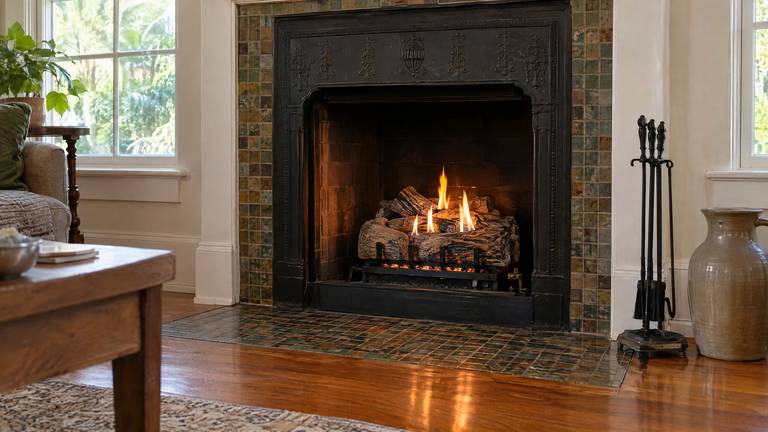
Gas Fireplace
From firebox check to first flame
Our experts measure the firebox and read the set's manual before anything is ordered.
Where a vent-free set is allowed
Vent-free sets carry room rules. The Florida fuel gas code keeps gas appliances out of bedrooms and bathrooms except in narrow cases, caps an unvented room heater at 40,000 Btu per hour and limits the total input of unvented appliances to 20 Btu per hour for each cubic foot of the room. One maker's vent-free manual also keeps units above 10,000 Btu per hour out of bedrooms and above 6,000 out of bathrooms.
We measure the room and compare it with the set's input before recommending a vent-free option. If the room is too small for the set you like, we tell you and suggest what would fit. The measurement goes into the written quote, so you can see how the chosen set compares with the limit for that room.
The gas line, and whose job it is
Our work is the appliance, meaning the burner, the logs, the controls and their fitting in the fireplace. New piping, a new stub into the firebox, meter work and propane tanks are outside that and go to a gas contractor, the utility or the propane supplier. Keeping the two apart means the quote you approve describes exactly what our technicians will do in your home.
The Florida fuel gas code calls for piping to be checked for leakage when gas is turned on, and for appliance connections to be checked before an appliance is put into operation. We coordinate with whoever handles the supply, and every connection we make is leak tested before the first fire.
Preparing the firebox for a vent-free set
Vent-free sets bring their own preparation rules. One maker's manual requires any outside air duct or ash clean-out door in the floor or walls of the fireplace to be permanently sealed with heat-resistant sealant before installation, while the chimney damper itself is never sealed. Those openings would let drafts reach the burner from below, which is why the manual asks for them to be closed off.
Those openings are found during the inspection, and the sealing work is listed in the quote. With the firebox prepared, the burner goes in on a clean, sealed floor exactly as the manual describes.
What happens on installation day
We protect the floor and the hearth, set the burner in its position, connect it at the appliance shutoff valve where the supply is ready and leak test every connection we make. Then the ember bed and logs go in to the diagram. Old sets that are being replaced are disconnected, capped where the manual requires and carried out before the new burner goes in.
We light the set, check the flame and the controls, and adjust until the flame matches the manual. The room is cleaned, the packaging and debris leave with us, and you get the walk-through and a written record of the work.


