
Chimney Services
Inside a chimney waterproofing job in Altamonte Springs
Repairs that come before any repellent
BIA guidance is direct about the order of work. The source of water penetration should be found and the necessary repairs completed before a water repellent is applied, and its list of repairs to finish first includes repointing cracked or disintegrated joints, replacing brick with spalled faces and replacing failed sealant.
The ChimneySaver instructions say the same thing in their own words, asking for structural cracks, faulty roofing, flashing, mortar joints and sealants to be repaired before application. On your Altamonte Springs chimney those repairs are quoted as separate lines, the repellent comes last, and you can approve the repairs without committing to the treatment.
The crown needs its own protection
The crown is a flat, exposed cap of concrete or mortar, and it is handled differently from the brick walls below it. The company behind one chimney wall repellent makes a separate brushable elastomeric coating for crowns, and its data sheet describes it curing into a flexible waterproof membrane over the crown.
A wall repellent sprayed across a cracked crown will not close the cracks. When your Altamonte Springs chimney's crown needs attention, crown repair or sealing is priced as its own line next to the waterproofing, so each part of the top gets the treatment made for it.
Roof safety during chimney waterproofing
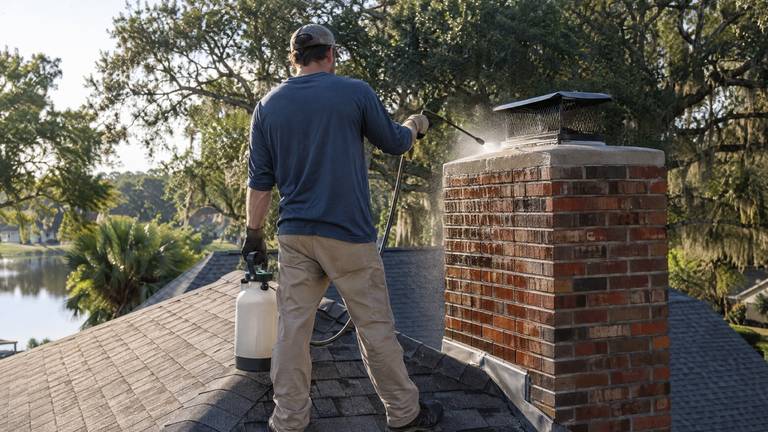
Repellent on a ladder rung or a roof surface makes it slick. The maker of one chimney repellent warns that product accumulating on ladders and scaffolding can create a slippery surface, and it recommends protective gloves and chemical splash goggles during use.
Our crew sets up with that in mind, keeps the area below the chimney clear and asks that children and pets stay inside while the product is applied and drying. The same instructions give a drying time of two to six hours, depending on temperature and humidity.
Visibly dry brick on the day of treatment
Dew, a passing shower or an overflowing gutter can leave brick damp even under a clear sky. The ChimneySaver instructions ask for visibly dry surfaces and rules out wet or saturated masonry, while Technical Note 6A notes that some siloxanes and silanes tolerate slightly damp surfaces.
Our crew checks the brick on each face before starting and waits for wet areas to dry, following the instructions for the product being used. That patience is part of a treatment that works.


