
Chimney Services
Getting the chimney cap right in Alderene Park
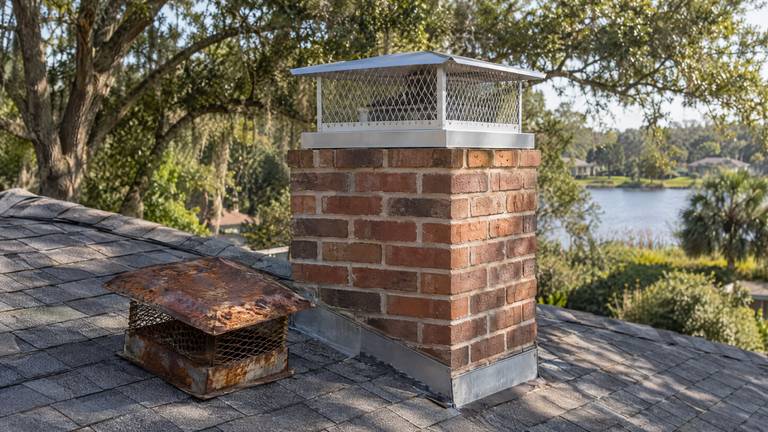
Chimney caps in Alderene Park replaced by our family-owned team after a free look at the flue top.
How a single-flue cap is fastened
Most single-flue caps drop over the tile and clamp to it with corner bolts. Installation guidance from HY-C, which makes caps, says those bolts must not penetrate the tile, and some of its caps put a metal ridge between each bolt and the tile to protect it. A tile that is already cracked cannot hold that clamp for long.
Our team tightens each bolt evenly, checks that the cap sits level and pulls on it by hand before leaving the roof. If the tile is chipped at the top, we show you and price the repair before fitting anything to it.
Decorative shrouds on metal chimneys
A decorative shroud can make a chase top look finished, but it also changes how heat and exhaust behave around a metal chimney. Under the Florida Building Code, a shroud may sit at the top of a factory-built chimney only when it carries a listing and label for use with that exact chimney system and goes on per its maker's directions.
If you want a shroud, we check whether one is listed for your system before quoting it. If an existing shroud has no listing for the chimney beneath it, we explain the concern and the options in writing.
Chimney swifts and your capping decision
Chimney swifts build their nests on the inside walls of chimneys while they breed. Federal law, the Migratory Bird Treaty Act, makes it illegal to harass, injure or kill the birds or to disturb their eggs or nests, as the U.S. Fish and Wildlife Service points out. They reach the country in March or April and head south in August or September.
The same agency asks owners not to cap a chimney just to keep wildlife out, and it advises capping a flue with a metal lining so birds are not trapped inside. The decision is yours, and we never fit a cap over an active nest.
Water in the firebox and the cap
Water on the hearth, a rusty damper or a musty smell after rain often starts at an open flue. A cap is the first thing we check, because it is the simplest fix when it is the cause.
Leaks also come through cracked crowns, loose flashing and porous brick, and a new cap does nothing for those. We trace where the water enters before recommending a cap, so you do not pay for one part while another keeps leaking.


