
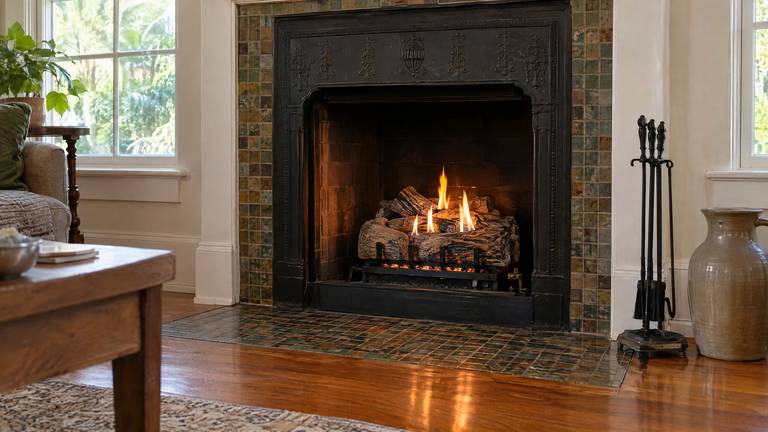
Use the quiet season for observation
A cold fireplace offers a chance to notice changes without operating it. Look only from the ordinary room position with the appliance off and cool. You do not need to remove covers, reach past a damper or climb onto the roof. The purpose is to decide whether to arrange assessment before use, not to inspect concealed parts yourself.
Compare what you can see with what you remember from the last service. A few fragments that appeared while the fireplace was unused are worth mentioning. Do not clear away all the evidence and then start a fire to see whether more arrives. Explain the appearance and location in ordinary terms, leaving identification to the technician.
Loose dark material is a clue, not a measurement
Soot, dark flakes or deposits around an accessible opening can prompt a cleaning assessment. The visible amount does not reliably measure deposits throughout the system. A tidy hearth can coexist with conditions farther up the passage, while material on the floor may have more than one source.
How to tell if your chimney needs cleaning is not a question answered by scraping a sample or measuring a surface you can barely reach. Report whether the material is powdery, flaky or mixed with other debris. Avoid touching sharp fragments or disturbing anything that may involve an animal. Keep children and pets away from the affected area until the condition is understood.
Ask whether sweeping is the appropriate first job or whether another condition must be addressed before cleaning can proceed. That question is especially useful when the debris includes pieces that do not look like soot.
Odor during disuse needs context
An odor noticed near an unused fireplace is useful information, but its strength does not identify a repair or quantify how much sweeping is needed. Describe where it is noticeable, when it appeared and whether water or debris is also present. Do not cover the smell with fragrance and regard that as a solution.
The useful distinction is between an observation and a diagnosis. “The room smelled different after the fireplace had been unused” gives the technician a starting point. “It needs a new liner” jumps to a major decision without the assessment. A cleaning appointment may help address deposits, but it should not be sold as a guaranteed cure for every odor.
If a carbon monoxide alarm sounds, leave the building and call 911 from outside. Do not treat an alarm as an ordinary odor complaint or wait for a routine chimney appointment.
Remember the last operating problem
Poor smoke movement during the last use still matters after a long break. EPA's archived wood-burning guidance identifies regularly seeing or smelling smoke as a possible problem. Tell the technician what was happening at that time, then leave cause-finding to the inspection. Sweeping, component condition and the way the system was being used may need to be considered separately.
Do not recreate smoke in the room to provide a demonstration. A remembered description is preferable to deliberately repeating an uncertain operating condition. If you have the appliance instructions, bring them to the visit so the installed system can be discussed accurately.
A chimney that needs sweeping may show signs that should be considered alongside that operating history. Dark deposits may support a cleaning recommendation, but they do not prove that deposits explain every complaint. Ask what remains unresolved after the proposed work.
Sort debris from a service request
- Dark loose material: describe the amount and where it appeared, without scraping or reaching into the passage.
- Pieces of masonry or other broken material: leave the fireplace unused and ask for assessment of the component condition before assuming ordinary sweeping is enough.
- Nest-like material or animal sounds: avoid disturbance and mention them at booking so the visit can account for appropriate handling and restrictions.
- Water or damp staining: explain whether it followed rain and whether previous work was intended to address it. Deposit removal and a water-entry repair are different jobs.
- A recalled operating problem: note the last known normal use and what changed. Do not start the fireplace to make the symptom happen again.
What a cleaning recommendation should explain
A useful recommendation identifies what is being removed and whether there are limitations to the work. Ask which opening or appliance is involved, whether another issue prevents completion and what should happen after the cleaning. This is particularly important in a house with more than one fireplace, where a single remembered visit may not have covered every system.
If the technician recommends repairs, ask for the connection between the finding and the proposed work. The fact that a cleaning is due does not automatically mean that a replacement component is needed. Conversely, clean visible surfaces do not resolve a damaged part. Keep those decisions separate when you review the estimate.
Our inspection is free. You can discuss the findings and the price of recommended work before approving the service, rather than guessing at the right job from a photograph or a stain.
Plan the return to use
Before returning the fireplace to use, ask whether the original concern has been addressed and whether any restriction remains. Keep the answer with the service record so another household member does not assume that a visit automatically cleared every outstanding issue. An incomplete visit or deferred repair should have an explicit next step.
Annual professional maintenance remains important even when no visible warning sign appears. NFPA's heating guidance recommends yearly professional cleaning and inspection; a symptom checklist does not replace that routine. Use visible changes to seek attention sooner, not as a reason to postpone an assessment indefinitely.
For an uncontrolled fire or suspected chimney fire, leave and call 911 from outside before contacting our team. After any immediate emergency has been handled, arrange chimney sweep service in Seminole County at (645) 465-4122. For routine bookings, describe the unused fireplace and what you noticed so we can discuss the visit.
Sources
- EPA Burn Wise: best practices: Archived guidance treats recurrent smoke as a possible operating problem.
- NFPA heating safety: Annual professional maintenance remains separate from homeowner observation.


