
Our Services
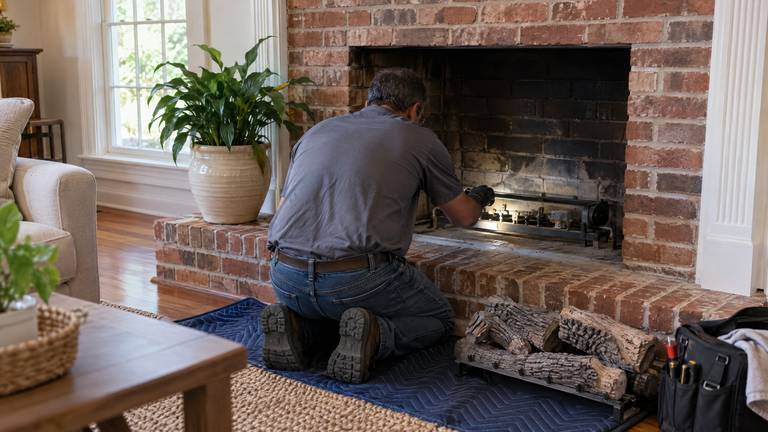
Inside a gas fireplace repair
Local pros, written prices and a 10% discount on services confirmed inside 72 hours of your free inspection.
Repair visit or scheduled service
A gas fireplace visit usually starts from one of two places. Either the unit has stopped working properly, because it will not light, will not stay lit or burns in a way it did not before, or it still works and is due for the routine cleaning and checks its maker calls for. The first is a diagnosis. The second follows a service list.
Both kinds of visit touch many of the same parts, so it helps to tell us which one you need when you call. For a fault, describe what the fireplace does and when it started. For a service visit, tell us roughly when it was last looked at. Either way, the first look is free and the price for the work comes before the work.
How a standing pilot keeps the gas on
Many gas fireplaces with a millivolt control use a pilot flame that burns all the time. On these units the pilot heats two small sensors. A thermocouple tells the valve that the pilot is lit, and a thermopile makes enough current to open the valve for the main burner when you flip the switch. The pilot flame has to wrap around both for this to work.
One maker's service instructions list a pilot flame too small to engulf the thermopile, a dirty or loose thermopile connection and a failing sensor among the reasons the main burner drops out. We check the flame, clean the connections and test the parts before anything is replaced.
Gas pressure checked at the valve
Gas valves on these fireplaces generally have test points for the pressure coming in and the pressure going out to the burner. The rating plate or the manual gives the range for each, and the range differs between natural gas and propane. Flames that are always too tall or too small can mean the burner is running above or below its rated input.
One maker's chart also links a pilot that flutters or shrinks when other gas appliances run to supply piping that is too small. Resizing piping is work for a gas contractor, and we tell you plainly when a reading points there. After a test point is opened, it is resealed and leak tested with a soap solution.
Direct-vent, B-vent or vent-free
Gas fireplaces fall into three broad groups. A direct-vent unit has a sealed glass front and draws outside air through a two-part vent. A B-vent unit uses air from the room and sends exhaust up a vent pipe. A vent-free unit has no vent at all and burns in the room, with a sensor pilot that shuts it off if the oxygen in the room falls.
Each group has its own checks and its own risks, so identifying the type is part of the first look. The Florida fuel gas code lists vented gas fireplaces, vented fireplace heaters and unvented room heaters under separate standards, and the service steps in each manual follow the same split.


