
Our Services
How our technicians find a gas fireplace fault
Every repair priced upfront, with no hidden fees, by a local family-owned team.
Running the fireplace when the power is out
How a gas fireplace behaves in a power cut depends on its controls. A millivolt unit with a standing pilot makes its own current and does not need household power to run the valve. Many electronic-ignition units do need power, and some carry a battery backup for that reason. One maker's manual adds that the batteries should come out of the holder once power returns.
Blowers and accent lights stop without household power either way. If you want to know what your unit will do in an outage, ask during the service visit. We show you the backup, if there is one, and how to use it safely.
Logs and embers go back exactly as the diagram shows
The logs, embers, rocks or glass in a gas fireplace are placed to a diagram for a reason. The flame is designed to move around them in a particular way. A log nudged onto a burner port or embers piled too thick can make the flame strike the media, which leaves carbon on the logs, the glass and even the outside wall around the vent.
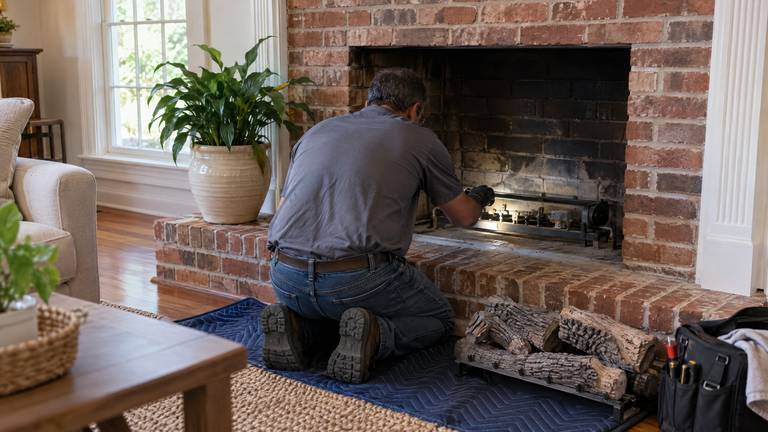
Before lifting anything for cleaning, we note where each piece sits, and we put it back to the manual's layout instead of to what looks good. If the set has been rearranged over the years, we restore the arrangement the manual specifies and show you what changed.
The screen in front of the glass
Gas fireplace glass can reach temperatures that burn skin, and it holds that heat long after the flame is out. Many newer models ship with a barrier screen in front of the glass to reduce that risk, and one maker's manual states that the barrier shall be installed and replaced with the maker's own part if it is damaged.
Barriers come off during service and go back before the fireplace is run again. If yours is missing, bent or loose, we can source the correct part for the model. Homes with toddlers may also want a safety gate, which that manual suggests for keeping small children away from hot surfaces.
The first fire after months off
Through the warm months, a fireplace that sits unused collects dust and lint in the burner, the pilot and the control compartment. One maker notes that carpeting, bedding and pet hair can add enough lint to call for cleaning more often than once a year.
A service visit before the first cool evening means the pilot, burner and glass are clean and the controls have been tested before you need them. If the unit lit poorly or smelled odd at the end of last season, mention it when you book so we look at that first.


