
Services
Before your chimney is rebuilt in Taintsville
Three things our masons in Taintsville explain before any brick comes down.
Tooled joints that shed water
The finish on a mortar joint affects how well it resists rain. Brick industry guidance favors concave, V-shaped and grapevine tooled joints for weather resistance, since tooling compresses the mortar surface and presses it tight against the brick.
Raked and struck joints can look sharp but leave small recesses or ledges where water sits. On a rebuild we tool the joints in the weather-resistant style you choose, and we keep that finish consistent from the first new course to the crown so the rebuilt section reads as one piece.
Joint width matters as well. We keep the new joints close to the width of the old ones so the rebuilt courses line up with the masonry that stays and the transition is hard to spot.
A cap sized to the rebuilt flue
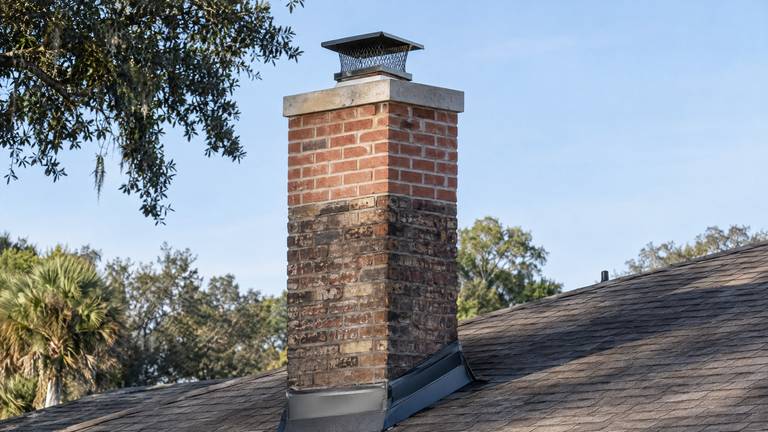
A rebuilt chimney is finished with a cap to keep out rain, animals and sparks. The Florida Building Code, Residential, requires a spark arrestor on a masonry chimney whose net free area is no less than four times the flue outlet's area, screen openings between 3/8 and 1/2 inch, and a screen or cap that comes off for cleaning.
A cap that is too small can choke the draft of a freshly rebuilt chimney, and one fixed in place makes every future cleaning harder. We size the cap to the finished flue and include it on the estimate as its own line.
The cap is fastened to the crown or the flue in a way that lets it come off for cleaning, and we show you how it attaches so future service is straightforward.
Work inside the house during a rebuild
Some rebuilds reach below the roof into the attic or the chimney breast inside the home. That can mean opening a ceiling, protecting finished rooms or working around wiring and insulation near the chimney.
We tell you in advance which rooms we need, how we will protect them and what other trades, such as a drywall or roofing contractor, might be needed afterward. The estimate separates our chimney work from anything outside our scope, so you know who handles what and nothing falls between two contractors.
If the chimney breast inside will be disturbed, we agree in advance how the surface will be left, so you know whether patching and painting are part of our job.


