
Fireplace Services
Fireplace installation from footing to first fire
A workmanship warranty, a clean site every evening and a price with nothing tucked away.
Offsets in the chimney route
A factory-built chimney can bend around framing, but only so far. Under the Florida Building Code, no part may lean more than 30 degrees from vertical and four elbows is the limit, while one chimney maker describes the same limit as two offsets.
We plan the route to stay inside those limits and lock each offset as the manual shows. When the house would need a steeper bend, we look for another route before anything is cut. Fewer bends also make the chimney easier to sweep and inspect in the years ahead, which keeps future maintenance simpler.
Protecting the fireplace during the build
A fireplace that gets wet before it is finished can carry the damage for years. One maker asks for the unit to be kept dry during construction and notes that wet insulation leaves a lasting odor. Water in the chase or on the firebox during the build can also stain finished drywall and ceilings below.
Until the roof and the chase are closed, the fireplace stays under cover, and the chimney opening is covered at the end of every work day. The site is swept and the debris hauled away before we leave.
Airspace around masonry
The Florida Building Code keeps combustible framing away from a masonry fireplace, with at least 2 inches of airspace at the front and sides and 4 inches at the back. That space is left open, apart from the fireblocking the code requires.
We frame the surrounding walls to those distances and check them before the drywall goes up. The airspace is invisible in the finished room and essential behind it. Behind a finished stone or brick face, that gap is the one part nobody sees again, so we check it twice before the face goes on.
Wood trim around a masonry opening
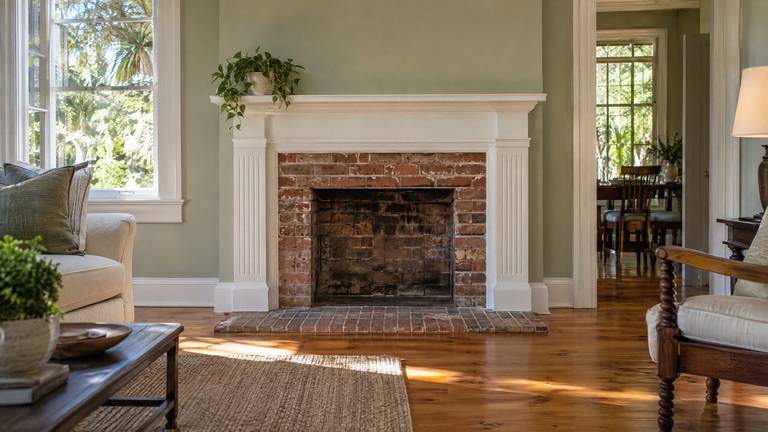
Wood mantels and trim near a masonry fireplace follow a code limit. Combustible trim may not sit within 6 inches of the fireplace opening, and trim within 12 inches is limited in how far it projects.
We share those limits with you and your carpenter before the mantel is chosen. A mantel that fits the rule from the start saves cutting or replacing it after the inspection. Stone and brick surrounds are noncombustible, which gives you more design freedom near the opening than wood does.


