Chimney Services
What a lasting crown repair takes
Crown repair in Midway follows a free inspection of the whole chimney top by our family-owned team.
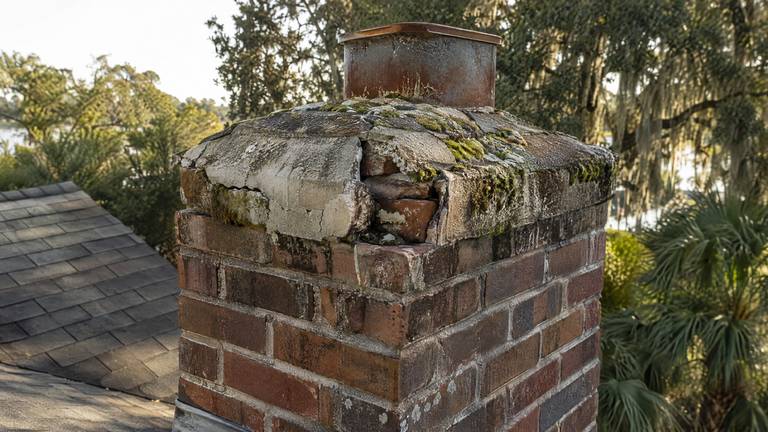
Why feathered edges crack first
A crown that thins out to nothing at its edge looks neat when new, but the thin rim breaks first. The Brick Industry Association warns against feathering the cap to the edge, since it substantially reduces the thickness there and raises the potential for deterioration.
Broken edges and missing corners are a typical sign of a feathered crown. Patching the rim with more thin mortar repeats the problem. We rebuild the edge with real thickness, or replace the crown when the thin rim runs all the way around.
A bond break around each flue
Clay or metal liners and the concrete around them expand and shrink by different amounts as they heat and cool. Lock the two together and the crown splits from the flue outward. It is why the state building code specifies a caulked break, per ASTM C1283, between the crown and every liner it surrounds.
On a crown we rebuild, each liner gets a separation and a flexible sealant joint so the two can move without damaging each other. On a crown we keep, we check the joint at each flue and reseal it when the old sealant has hardened or pulled away.
What we check on the chimney top
A crown inspection covers the surface, the edges and the overhang, the slope and any low spots, the joint around each flue, the liner projection, the drip under the edge and the top courses of brick. We also look at the cap and the flashing while we are up there.
Each repair option comes with a plain explanation and its own written price. The inspection is free, and nothing starts until you approve the work. If the crown is sound, we tell you that too, so you do not pay for work the chimney does not need.
Keeping the chimney's height when rebuilding
Rebuilding the top must leave the chimney tall enough. The Florida Building Code measures that two ways, 3 feet or more above the highest point where the chimney leaves the roof, and 2 feet or more above anything on the building within 10 feet of it.
When a crown is removed and replaced, we keep the finished height and the liner projection where they belong. If the chimney was already short before the work, we tell you and explain what raising it would involve before anything is decided.


