
Repair Options
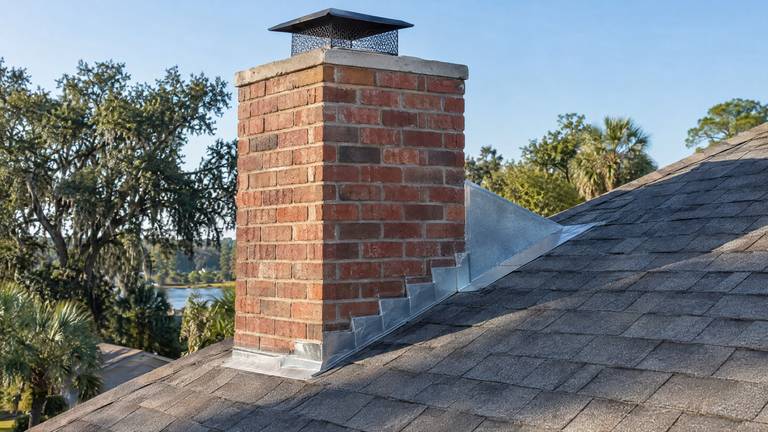
Step, apron and counter flashing work in Midway
Laps that send water over the joint
Flashing works because each piece overlaps the one below it in the direction water flows. Reverse a lap and the water is guided underneath instead. Brick Industry Association guidance is that flashing and counter flashing be lapped so water cannot get behind the inner layer, with every bend or break completely sealed.
Every lap is checked for direction as well as for whether metal is present. Our experts explain what they find on your Midway chimney in plain terms, and every repair carries our 100% satisfaction guarantee.
The uphill side where water gathers
Water running down the roof hits the uphill face of the chimney full on. On a narrow chimney, a back pan of flashing turns it aside. A wider chimney needs a cricket, also called a saddle, and section R903.2.2 of the Florida residential code requires one on the ridge side whenever the chimney is more than 30 inches across, measured perpendicular to the slope, so the flow divides around the chimney rather than pooling behind it.
Back flashing and whether a cricket is present get checked too, and you learn whether the chimney width calls for one. That check is part of the free inspection in Midway.
Metal thickness the code sets
Florida's residential code requires flashing at wall and roof intersections and around roof openings, in section R903.2.1, and Table R903.2.1 sets minimum thicknesses for each flashing metal, from copper and aluminum to stainless and galvanized steel. Thin, soft offcuts bent by hand may not meet it.
We use flashing stock that meets the table for the metal chosen, and we will tell you what it is. Book a free flashing inspection for your Midway home and see the material on the estimate.
Flashing on a stucco-finished chimney
Many chimneys are finished in stucco rather than bare brick. The counter flashing cannot simply be let into a brick joint, so the detail depends on what sits behind the finish and how the stucco ends above the roof. A crack where the stucco meets the flashing is a common entry point for water.
The finish, the flashing and the line where they meet all get checked, and we tell you whether stucco chimney repair belongs in the same job. Both can be scheduled together for your Midway home.
Water that gets in at the top of the chimney
Water that enters through a cracked chimney top or around the flue tile can run down inside the chimney and show up near the roofline. Florida code section R1003.9.1 wants the masonry chimney cap to have a drip edge, with a caulked bond break where it meets each flue liner, and the Brick Industry Association adds flashing below the crown.
Reflashing will not stop a leak that starts at the top. We check it on every flashing visit in Midway and quote chimney crown repair separately if it is needed.


