
Chimney Services
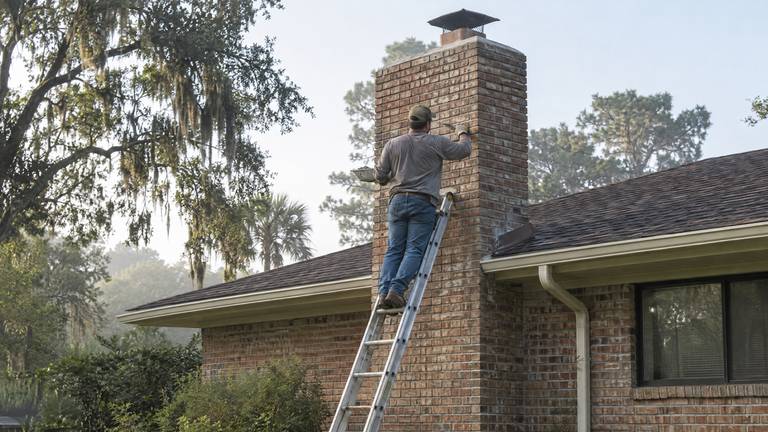
Inside a tuckpointing job in Indian Mound Village
What chimney tuckpointing replaces
Homeowners tend to say tuckpointing and masons say repointing. The Brick Industry Association's maintenance guidance describes the job as cutting damaged or deteriorated mortar back to an even depth and filling each joint with new mortar. The brick stays where it is, and only the mortar between the units is renewed.
That distinction matters when you compare quotes. A thin smear of mortar over the old joints, or a coating brushed across the whole chimney, is a different job with a different result. On a chimney in Indian Mound Village our specialists write down the method, the depth and the area of joints included, so you can see what the price buys.
Tooling new joints at thumbprint hardness
Timing the tooling decides both how well a joint sheds water and how it looks. Technical Note 7B describes thumbprint hard as the point where a thumb leaves an impression but picks up no mortar. Tooled too early, joints smear and can turn out lighter in color. Tooled too late, the surface cannot be consolidated against the brick.
The Park Service brief adds that joints tooled when too hard can show dark streaks known as tool burning. On a chimney the faces set at different speeds depending on sun and wind, so our crew checks each area before tooling it.
Hairline mortar cracks and face grouting
For very fine cracks in otherwise sound joints, Technical Note 46 describes face grouting, where a thin grout of cement, lime and fine sand is brushed into the cracks, usually in two coats. The note warns that the joints look slightly wider and smoother afterwards, and says repointing is generally recommended because it corrects more kinds of deterioration.
We mention face grouting when a chimney genuinely fits it and explain the change in appearance before you decide. Where the mortar is soft, recessed or hollow, grouting will not hold, and repointing is the repair we quote.
Softer mortar for older brick
Early masonry mortars were mostly lime, with little or no portland cement, and had lower strength. Technical Note 8B concludes that repairing older masonry will likely call for a weaker mortar than new construction, noting that Type O is often used to repoint older brickwork while Type N may suit newer brickwork.
The principle holds at any age. The new joint should be the part that gives, rather than the brick. Our specialists match the mix to your chimney's brick and existing mortar, whatever year it was built, and explain the choice before work begins.


