
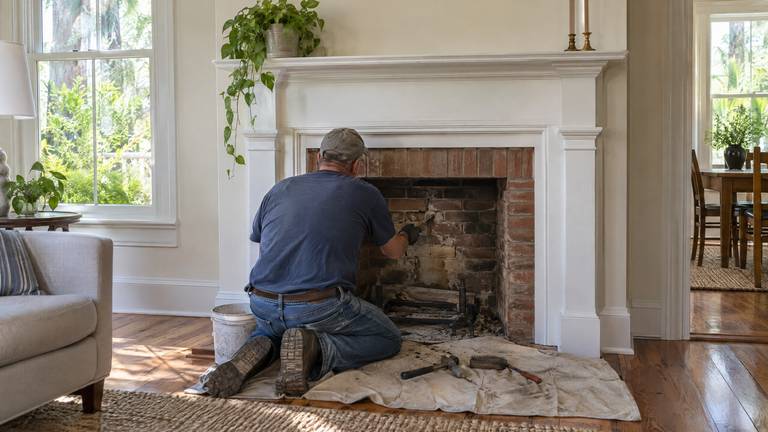
Fireplace Repair
Hearth repair done properly in Geigers Landing
Hearth repair from local craftsmen who look underneath before they lay anything on top.
What the hearth extension is there to do
The extension keeps heat, sparks and rolling embers off the floor in front of the fire. For that reason, the code for masonry fireplaces requires a concrete or masonry extension on noncombustible supports, strong enough to carry its own weight and whatever is placed on it. It is also the place where a log that rolls forward lands, so it takes heat as well as foot traffic.
A repair has to keep all of that intact. A handsome new finish that sits on a weak or combustible base looks right and fails at the one job the extension exists for. We check the job before we talk about the finish.
Framing kept clear of a masonry fireplace
Behind and around a masonry fireplace, the code wants combustible framing kept 2 inches or more away at the front and sides and 4 inches or more at the back, with the air space left open except for fireblocking. A deep hearth repair can expose the edges of that framing. Those gaps keep the wood around the fireplace from being heated by the masonry over years of use.
When a repair opens the hearth far enough to see the framing, we check those gaps before closing it again. If framing sits too close, we explain what we found and how it can be corrected, and nothing is covered over without your agreement.
Raised hearths and seating ledges
Many fireplaces sit on a raised hearth, sometimes deep enough to sit on. The raised section takes knocks from feet, logs and tools, and its front edge and corners chip and crack more than the flat surface. Seating ledges also take weight from people sitting on them, which puts extra load on the front edge.
Where the firebox floor is raised at least 8 inches above the extension, the code for masonry fireplaces allows a thinner extension in front. We check the heights before a repair so the rebuilt ledge and the extension in front of it keep to the thickness that applies. Chipped edges can often be rebuilt or replaced without disturbing the rest.
Brick hearths and loose bricks
Brick hearths loosen one brick at a time. A brick that rocks, a joint that has crumbled or a corner that has broken away usually means the mortar under or around it has failed, and heat and foot traffic finish the job.
We remove loose bricks, clean out the old bed, reset them in fresh mortar and match the joint to its neighbours as closely as the mortar allows. Salvaged or matching brick is used where the original is broken. If many bricks are loose, we look at the base before resetting any of them. We brush the finished joints to the same profile as the old ones so the repair sits comfortably beside them.


