
Fireplace Services
Fireplace installation from footing to first fire
A workmanship warranty, a clean site every evening and a price with nothing tucked away.
Insulation, vapor barriers and the fireplace
One maker's manual says the fireplace must not be placed against a vapor barrier or exposed insulation, and an outside wall or a chase may contain both. That matters whenever the fireplace goes on an exterior wall.
We check what the wall contains before we set the unit and frame the space so the fireplace body stays clear of those materials. Where the manual calls for a lined enclosure, we build it that way. Any insulation we move is put back around the enclosure, so the wall keeps its insulation and the fireplace keeps its clearances.
Hearth extension rules for factory-built units
A factory-built fireplace uses the hearth extension its listing calls for, and the Florida Building Code asks for that extension to be readily distinguishable from the surrounding floor. Listed hearth extensions are tested to UL 1618.
We plan the hearth with the flooring so the extension is the right size and material and clearly marked off from the floor. One maker also uses metal hearth strips at the front of the unit, which we fit as the manual shows. If new flooring is planned, we set the extension height with your flooring installer so the two meet cleanly.
Mantel limits on a factory-built fireplace
One maker sets a combustible mantel no lower than 12 inches above the fireplace opening and no deeper than 12 inches, and it limits how close projecting trim may come to the top of the opening. Trim is never placed over the black metal of the unit.
We check your mantel choice against the manual for the model you pick. If the mantel you love does not fit the limits, we tell you before it is ordered. A mantel set too low can also crowd the view of the fire, so staying inside the manual's limits usually suits the look as well.
Wood trim around a masonry opening
Wood mantels and trim near a masonry fireplace follow a code limit. Combustible trim may not sit within 6 inches of the fireplace opening, and trim within 12 inches is limited in how far it projects.
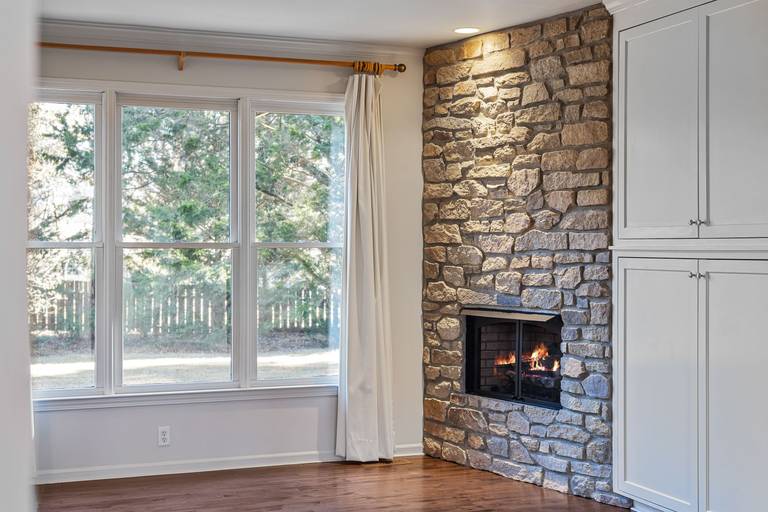
We share those limits with you and your carpenter before the mantel is chosen. A mantel that fits the rule from the start saves cutting or replacing it after the inspection. Stone and brick surrounds are noncombustible, which gives you more design freedom near the opening than wood does.


