
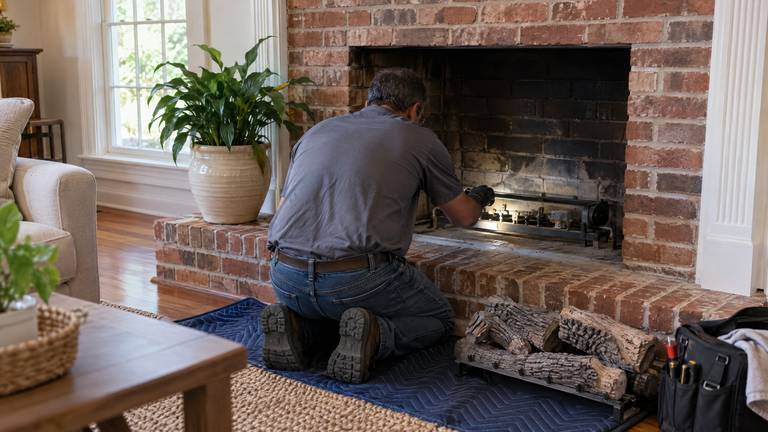
Gas Fireplace
Gas fireplace care from pilot to vent cap
Every repair carries our workmanship warranty, and our 100% satisfaction guarantee as well.
When the pilot goes out as you let go of the knob
On a manually lit pilot, the knob is held in while the thermocouple warms. If the pilot dies the moment you release it, one maker's troubleshooting chart points to a pilot flame that does not reach the thermocouple, a loose or dirty thermocouple connection, a worn thermocouple or a faulty valve.
That same chart notes a safety interlock that will not let the pilot relight until the thermocouple cools, about a minute on that model. Repeated attempts in a row do not help, and holding the knob longer does not fix a weak sensor. Leave the unit off and let a technician test it.
The screen in front of the glass
Gas fireplace glass can reach temperatures that burn skin, and it holds that heat long after the flame is out. Many newer models ship with a barrier screen in front of the glass to reduce that risk, and one maker's manual states that the barrier shall be installed and replaced with the maker's own part if it is damaged.
Barriers come off during service and go back before the fireplace is run again. If yours is missing, bent or loose, we can source the correct part for the model. Homes with toddlers may also want a safety gate, which that manual suggests for keeping small children away from hot surfaces.
Exhaust odor near the fireplace
When a carbon monoxide alarm goes off, get everyone outside first and make the 911 call from there. Nobody should stay behind to look for the source.
A fireplace that smells of exhaust while it runs, or leaves people with headaches in the room, needs checking before it is used again. One maker's troubleshooting guide traces exhaust in the room to spillage and lists the door seal, damage to the vent, the way the vent was installed and a room under negative pressure as causes to check. We work through each one and explain what we found in writing.
Carbon monoxide alarms near a gas fireplace
You cannot see or smell carbon monoxide, which is why most homes get no warning without an alarm. The U.S. Consumer Product Safety Commission wants carbon monoxide alarms outside sleeping areas and on every level of the home, running on batteries or with battery backup. One fireplace maker also recommends a detector in the same area as the appliance.
When an alarm sounds, everyone goes outside and 911 is called from there, before anyone thinks about the fireplace. Once the house is safe, a service visit can check the appliance, the vent and the seals for anything that could be releasing exhaust. We can also point out sensible alarm positions near the fireplace, following that placement advice.


