
Our Process
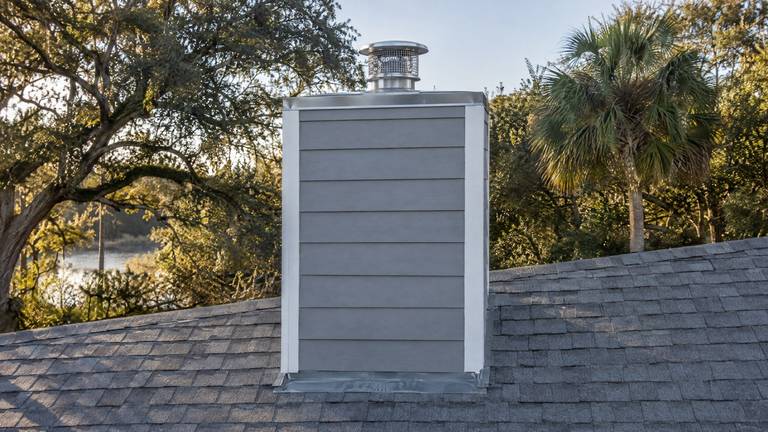
Chase cover work on Sanford homes
Galvanized or stainless steel for the new cover
A zinc coating is what protects galvanized steel. According to the American Galvanizers Association, temperature, humidity, rainfall, sulfur dioxide and air salinity decide how quickly that coating is used up, and once it is gone the steel beneath begins to rust.
Stainless steel does not depend on a coating and costs more to buy. Our team prices both metals side by side for your Sanford home, so the choice is made with the real difference in front of you. Whichever metal you choose, the cover still needs slope, a raised collar and a drip edge, and our specialists explain how each metal is expected to age on a well-drained top.
Where the cover skirt meets the siding
The turndown of a chase cover laps over the top edge of the wall covering, whether that is lap siding, panels or a stucco finish. That junction decides whether water leaving the drip edge falls away or finds a path behind the siding. Stucco needs particular care at that edge, since a crack there lets water behind the finish.
When we measure for the replacement, we note the siding type and its condition at the top course. Cracked trim, open joints or failed stucco at that line are pointed out during the free inspection, so the new cover never goes on over a leak it cannot stop.
Pipe height above the new cover
Changing a chase cover must leave the chimney pipe at the height its instructions require. The Majestic manual has the last pipe section end between 2 inches above and 4 3/4 inches below the top of the chase, with the bottom of the cap no less than 3 feet above the roof and 2 feet higher than any roof surface within 10 feet.
We confirm those relationships before and after the swap. If an earlier repair left the pipe short or the cap too low, it is written up during the free inspection instead of being hidden under new metal.
A cover that dips in the middle
A chase cover that has sunk into a shallow bowl is holding water every time it rains. The cause is usually below it: a softened deck, missing support, or a sheet too thin for its span. Swapping the metal alone would bring the same bowl back.
We find out why the old cover sagged before the new one is fabricated. The fix may include restoring support at the top of the chase, which our specialists price separately and explain before you approve the work on your Sanford home.


