
Our Services
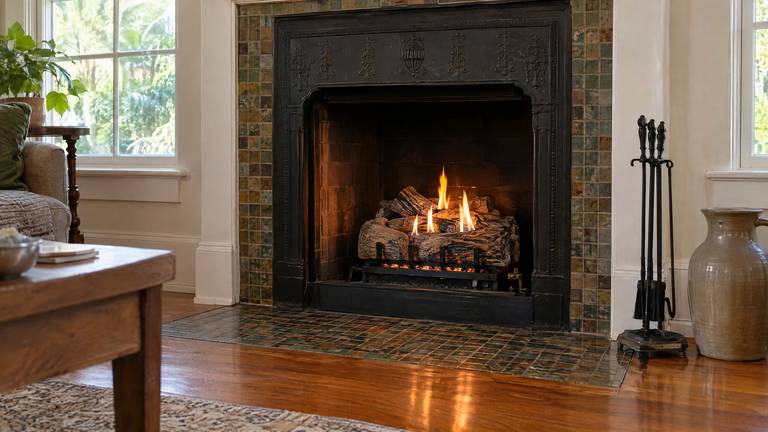
Choosing and fitting your gas logs
Everything is priced in writing before you pick a set, and there is no charge for the inspection.
No wood fires once the set is in
A fireplace fitted with a gas log set becomes a gas fireplace. One maker's manual states that solid fuels must not be burned in a fireplace where a decorative gas appliance is installed. Burning wood on or around a gas burner can damage it and the logs. A decorative gas set sits where the wood fire used to be, and the two cannot share the same firebox.
If you still want the option of a wood fire, the set is the wrong choice for that fireplace, and we would rather tell you before installation. For homes that are ready to move to gas for good, we remove what the wood fires left behind and fit the set in a clean firebox.
Hot logs and hot glass
Gas logs and the surfaces around them stay hot for some time after the flame goes out. One maker's manual asks that children and adults be warned about hot surfaces and that anyone repositioning a log use heat-resistant gloves or wait until it has cooled. The glass doors, the screen and the fireplace face around the opening can also stay warm well after the fire is off.
We point out the surfaces that get hot and the safe way to reach the controls. Homes with small children may want a sturdy screen or safety gate in front of the fireplace, and we can suggest where it should sit.
Replacing an old gas log set
Replacement starts with identifying what is installed. We look for the set's label, the burner, the valve and the ignition type, and check which parts are still sound and still supported by their maker.
Often the right answer is a complete new set, burner, valve and logs together, because the parts are designed and listed to work as one. When only the logs are worn and the maker still supplies them, a log replacement may be enough. The quote spells out which it is, what gets removed and what stays. If the old set used a different fuel from the one your home has now, the whole arrangement is replaced to match the supply.
Carbon monoxide and a gas log set
Any gas fire can make carbon monoxide if it burns badly, and the gas has no color or smell. The U.S. Consumer Product Safety Commission advises carbon monoxide alarms that run on batteries or have battery backup, placed on each floor of the home and outside the bedrooms. A set that is installed and serviced correctly burns cleanly, and an alarm is the backstop if something changes.
If an alarm goes off, everyone goes outside, and the call to 911 is made from there. One maker's manual also lists headache, dizziness and nausea as early signs and says to get fresh air and stop using the appliance at once.


