
Chimney Services
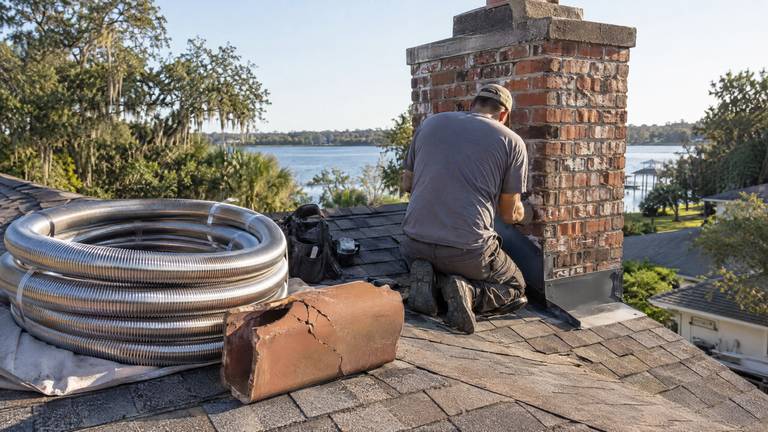
Relining the chimney from top to bottom
The finished liner carries our workmanship warranty, and the bill carries no hidden fees.
Listed liner systems
Metal chimney liner systems are tested and listed to UL 1777, the safety standard for chimney liners. A listed system is a set of parts, including the liner, its connectors, the top plate and the cap, tested to work together.
We install listed systems according to their instructions and do not mix parts from different makers. The system details are written into the estimate and left with you after installation, so any future work can follow the same listing. Keeping the listing intact also matters when a part needs replacing later, since a substitute from another system may not carry the same listing.
Cleaning before the liner goes in
One manufacturer asks for the chimney and smoke chamber to be swept clean of soot and creosote, glazed deposits included, before its liner is installed. Deposits left behind the new liner can still smoke or smell.
We clean the passage as part of the relining work, or ahead of it when the deposits are heavy. The cleaning is priced in the estimate, and anything the cleaning reveals about the old lining is explained before installation continues. Cleaning also lets the route test run through a clear passage, which gives a truer answer about whether the chosen liner will pass.
When a liner needs insulation
Under UL 1777, insulation is required when the chimney does not meet the construction standard for its walls and clearances. One maker also notes that insulation helps the draft, keeps exhaust warmer and reduces condensation.
Insulation is part of the listed system, never an optional extra to drop when space is tight. We explain whether your chimney needs it and include the insulation, its fitting and its effect on liner size in the estimate. Where the passage is too tight for an insulated liner of the required size, we explain the alternatives rather than leaving the insulation out.
Height of the liner at the top
A chimney has to clear its roof. The Florida Building Code puts the top at least 3 feet above the point where the chimney passes through the roof, and no part of the building within 10 feet may reach higher than 2 feet below that top.
A liner's termination follows the chimney top, so we check the height before relining. Where the chimney falls short, a listed extension or another change is discussed as part of the plan rather than left for later. The height is taken with a measurement at the roof, never estimated from the ground.


