
Our Services
How we repair chimney leaks in Gabriella
Local specialists, upfront pricing and a 100% satisfaction guarantee on every leak repair in Gabriella.
Controlled water testing
When inspection alone cannot separate the possible paths, a controlled water test can. Water is applied to one area at a time, starting low and working upward, while someone watches inside for the first sign of moisture.
Testing one area before the next keeps the result readable. A broad soaking of the whole chimney only proves that water gets in somewhere. We explain in advance what each test can show, how long it will take and how the room will be protected while it runs. A test that shows nothing is reported as exactly that, with its limits.
Water repellents come after repairs
A breathable, penetrating water repellent can reduce how much rain sound brick absorbs. The Brick Industry Association advises considering such treatments only after the brick, the mortar joints and the other elements have been repaired.
Film-forming coatings can trap moisture inside the wall and push the brick face off. We use products that let vapor leave the masonry and apply them to the maker's instructions. A repellent is offered only where the brick needs it, and it is priced as a separate line from the leak repair itself.
Where sealant helps and where it does not
Sealant has a place in chimney work, at the bond break around the flue tile and along the top edge of counterflashing. Used as a patch over failed flashing or a broken crown, it holds only briefly.
Old sealant patches get special attention during the inspection because they often mark where an earlier leak was found. Where a patch is covering a failed part, the part itself is repaired. That is how a leak repair stays repaired after the next few storms.
A drip edge that throws rain clear
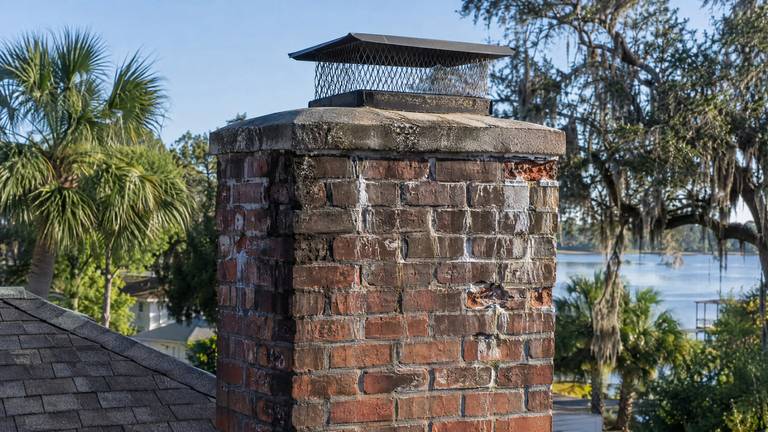
When a crown stops flush with the chimney face, water runs straight down the brick. A crown that overhangs with a drip edge breaks that flow and drops the water clear of the wall.
When we rebuild a crown, the overhang and drip edge are formed as part of the new work. On an existing crown with no overhang, we explain whether a rebuild or another detail would reduce the water reaching the faces, and what each option would change.


