
Gas Fireplace
Gas fireplace care from pilot to vent cap
Gas fireplace repair and maintenance from local technicians who test before they replace.
A slow or uneven light-up
When the burner lights, the flame should spread across every port quickly. One maker describes a total light-up of 5 to 10 seconds as satisfactory and asks for service when ignition takes longer. A burner that lights in patches, rolls flame out of the front or lights with a soft thump is telling you something.
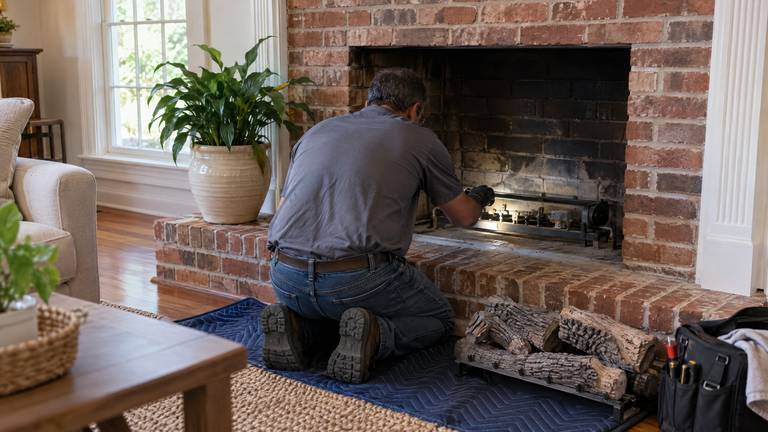
Ports clogged with lint, a dirty pilot, low gas pressure and media sitting where it should not are all possible reasons. We clean the ports and the pilot assembly, reset the logs to the diagram and measure the pressure if the light-up is still slow afterward.
The screen in front of the glass
Gas fireplace glass can reach temperatures that burn skin, and it holds that heat long after the flame is out. Many newer models ship with a barrier screen in front of the glass to reduce that risk, and one maker's manual states that the barrier shall be installed and replaced with the maker's own part if it is damaged.
Barriers come off during service and go back before the fireplace is run again. If yours is missing, bent or loose, we can source the correct part for the model. Homes with toddlers may also want a safety gate, which that manual suggests for keeping small children away from hot surfaces.
After water reaches the controls
Gas fireplace manuals are firm on this point. If any part of the appliance has been under water, it must stay out of use until a qualified technician has inspected it and replaced every control system part and gas control that was submerged. Drying it out and trying the switch is no test at all.
Water can reach a fireplace from a roof leak, a burst pipe or storm water inside the house. Tell us what happened and how high the water reached. We check the valve, the ignition parts and the wiring, and we list the parts the manual says must be replaced before the unit runs again.
Parts that match your model
A part that fits the connection is not automatically the right part. One maker specifies a fast acting thermocouple for its millivolt model and says to replace it only with the thermocouple it supplies. Another manual warns against installing damaged, incomplete or substitute components of any kind.
We order replacement parts by model and serial number from the parts listed for that appliance. If a part has been discontinued, we tell you what approved alternative exists, if any, and whether the repair still makes sense against replacing the unit. New parts are fitted and tested the way their instructions describe.


