
Chimney Services
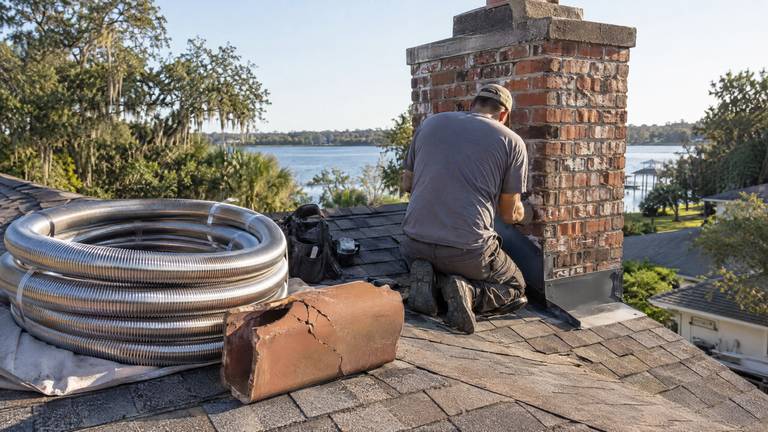
Liner installation details for Altamonte Springs homes
When the inspection leads to relining, 10% comes off if you book within 72 hours.
Flue size for an open fireplace
An open masonry fireplace needs a flue area in proportion to its opening. The Florida Building Code sets that proportion at one-twelfth of the opening for a round flue, one-tenth for a square flue and one-eighth for a rectangular flue whose sides differ by a ratio of 2 to 1 or more.
A liner too small for the opening can leave smoke spilling from the front of the fireplace even when everything else is sound. We measure the opening and the flue before recommending a liner for an open fireplace. When the existing passage cannot hold a liner of the required area, we explain what that means for an open fireplace and what the alternatives are.
When the flue is too large
An oversized flue gives exhaust more room than it needs, so it moves slowly and cools on the way up. One liner maker's instructions link incorrect sizing to condensation, creosote build-up and poor draft.
Relining with a liner sized to the appliance restores a passage in proportion to the exhaust. We explain the current flue size, the size the appliance calls for and the difference a new liner would make before you decide. For a gas appliance, the same mismatch tends to show up as moisture, so the liner size is checked against the appliance instructions rather than the old flue.
Clearances that cannot be confirmed
Where the space between the chimney and nearby framing cannot be seen or measured, the clearance is unknown. One liner maker calls for an approved insulation wrap in that situation.
When clearance cannot be confirmed from the accessible areas, you hear that from us, along with how the liner plan accounts for it. The finding is stated plainly rather than assumed, since concealed framing is where heat can do harm without being seen. If a finished wall or ceiling hides the chimney, we explain whether opening a small area would settle the question.
Keeping the liner record
After relining, you receive the system name, the liner size and material, and the parts installed at the top and bottom. Keep this information with the appliance manual.
If the appliance is replaced later, that record lets the next inspection check quickly whether the liner suits the new model. It also helps any future repair use parts from the same listed system. The same record answers questions from a buyer or a home inspector if the house is sold.


