
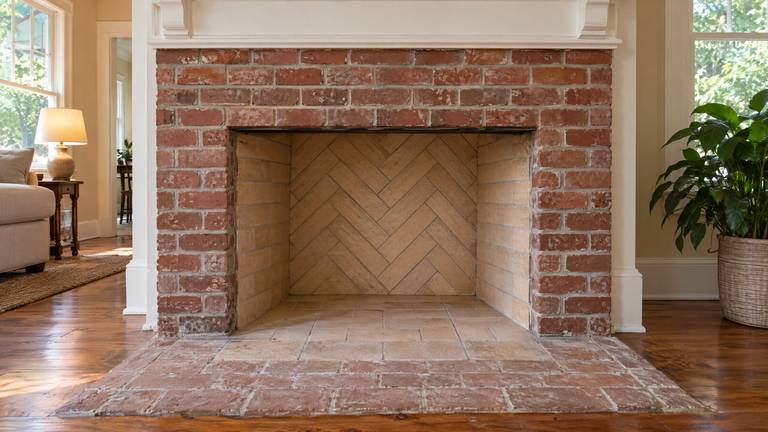
Find the boundary of the damaged firebox
A small visible defect does not necessarily describe the whole repair. During cracked firebox repair assessment, we look at where the line starts, whether adjacent material is loose and whether an earlier patch covers the area. A repair can only be planned sensibly when the receiving surface is understood. We explain what is visible and what cannot be settled without further access. The fireplace should stay unused while an unresolved interior defect is being assessed. Homeowners sometimes use the word brick for a molded interior panel. Those assemblies need different decisions. A factory-built panel belongs to its appliance system, while this service concerns a masonry interior. Establishing that distinction early avoids choosing a material simply because it resembles the surface already there.
Decide whether to keep or replace the firebrick
Fireplace firebrick replacement removes damaged units where a compatible replacement is appropriate. We identify the affected wall or floor area and discuss the condition of the surrounding units. Firebrick repair should not be sold as a surface touch-up when material is no longer sound beneath it. Conversely, a limited repair does not automatically require dismantling every interior surface.
The proposal should make the removal boundary understandable. Ask which units stay, which are replaced and whether reaching the defect affects neighboring joints. Matching appearance is part of the conversation, but the product must first suit the fireplace application. We also discuss whether an exact visual match is available before the work begins.
Choose joint material for the actual application
Fireplace mortar repair concerns the joints between suitable masonry units. Product instructions determine preparation, application limits and curing. RUTLAND, for example, publishes a specific heat-curing procedure for its fireplace mortar; that procedure is not a rule for every refractory product. We give instructions for the material actually installed instead of asking you to judge readiness by its surface color.
Existing coatings and loose patches matter when defining preparation. A new layer over a weak receiving surface does not explain how the defect has been addressed. Your fireplace brick repair estimate should identify any removal needed before new material goes in, along with what happens if that removal reveals more deterioration.
Understand when the work becomes a rebuild
A firebox rebuild is a broader intervention than replacing an isolated damaged brick. The decision depends on the extent of unsuitable material, access and the condition of the assembly. We describe the specific interior being reconstructed so that the phrase fireplace rebuild does not blur into a promise to replace the entire chimney or decorative surround.
An itemized scope also helps if you have received proposals using different names. Compare the area included, the work needed to reach it and the remaining exclusions. A lower price for a smaller patch is not a like-for-like alternative to a larger reconstruction. We can explain the practical difference without assuming the more extensive option is necessary.
Keep the surrounding fireplace in the discussion
An interior repair does not settle every concern above or around the opening. Mention any earlier water entry, displaced material or difficulty using the fireplace when you arrange the visit. These observations help us decide whether a separate issue needs attention before the proposed firebox work can be relied upon.
The hearth in front of the opening and the decorative facing have their own functions and repair boundaries. If either also needs work, it should appear as a separate line of the plan rather than an unexpected addition. For a wider project, we can discuss fireplace repair alongside the interior findings.
Know what to keep after the repair
Keep the material details and instructions supplied with the completed work. If a change appears later, being able to identify the repaired section is more useful than a general description of the whole fireplace. Follow the specified return-to-use procedure, including any staged curing directions, and contact us about a new loose area before using the unit again. We close the job by explaining what was repaired, what remains outside the agreed scope and how to raise a follow-up concern. This is particularly useful when another member of the household will use the fireplace. The repair information should be easy to pass on without guessing what product was used or when the work was completed.


