
Chimney Services
What a lasting crown repair takes
Crown repair in Sanford follows a free inspection of the whole chimney top by our family-owned team.
A bond break around each flue
Clay or metal liners and the concrete around them expand and shrink by different amounts as they heat and cool. Lock the two together and the crown splits from the flue outward. It is why the state building code specifies a caulked break, per ASTM C1283, between the crown and every liner it surrounds.
On a crown we rebuild, each liner gets a separation and a flexible sealant joint so the two can move without damaging each other. On a crown we keep, we check the joint at each flue and reseal it when the old sealant has hardened or pulled away.
Using the fireplace after crown work
Heat from a fire warms the flue and the crown around it, and a crown that has not cured can be stressed before it is ready. Coatings have their own drying times, which depend on the weather at application.
Before we leave, you get a clear answer on when the fireplace can go back into use. If you were planning a fire for a particular evening, tell us when you book so we can schedule the work around it.
Crowns with layers of old patches
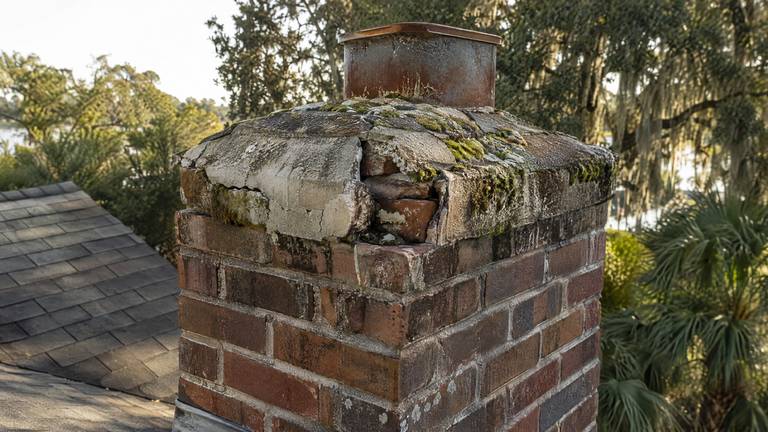
Some crowns carry several generations of repairs, with mortar patches, caulk in the cracks and a coating or two on top. Each layer may have held for a while, but together they hide the condition of the crown underneath. Caulk smeared across cracks can also keep a new coating from gripping the surface.
Adding another patch rarely solves anything at that point. We check what is under the layers, and if the original crown has failed, we recommend removing it and forming a new one. You see why before you decide.
A yearly look at the chimney top
Under NFPA 211, the national standard for chimneys and fireplaces, a chimney should get an inspection every year. The crown gains a lot from that check, because small cracks are simple to seal and large ones are not.
A yearly look catches hardened sealant, new hairline cracks and edge damage while they are still minor. We can combine it with a sweep or a cap check on the same visit, each priced separately. A crack that has grown between two yearly visits tells us more than a single look ever could.


