
Chimney Services
Getting the crown right on your Forest City chimney
Same-day crown inspections are available in Forest City when the schedule allows.
Sealant at the flue joint
Around each flue liner, the crown is finished with a bead of flexible sealant in place of rigid mortar, and that bead wears out long before the concrete does. The Brick Industry Association recommends a good grade of polysulfide, butyl or silicone rubber sealant, installed with proper priming and backing, and advises against oil-based sealants.
A hardened, cracked or missing bead lets water run straight down the outside of the liner. Resealing that joint is a small job when the crown itself is sound, and we check it on every crown we look at.
Loose brick under the crown
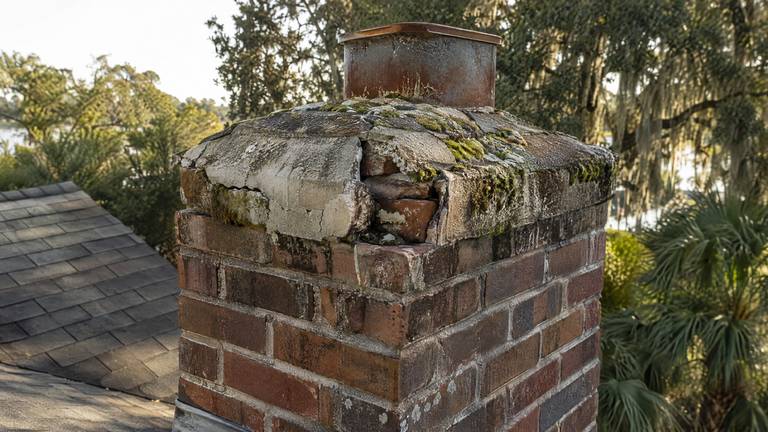
Water that gets past a failing crown soaks the top courses of brick first. Mortar joints soften, bricks loosen and faces begin to flake. A new crown set on loose brick will crack along the same lines as the old one.
We check the upper courses at every crown inspection. Where they are sound, the crown work goes ahead on its own. Where they are loose, we reset or replace them first and list that masonry work separately on the estimate.
Keeping the chimney's height when rebuilding
Rebuilding the top must leave the chimney tall enough. The Florida Building Code measures that two ways, 3 feet or more above the highest point where the chimney leaves the roof, and 2 feet or more above anything on the building within 10 feet of it.
When a crown is removed and replaced, we keep the finished height and the liner projection where they belong. If the chimney was already short before the work, we tell you and explain what raising it would involve before anything is decided.
Crowns with layers of old patches
Some crowns carry several generations of repairs, with mortar patches, caulk in the cracks and a coating or two on top. Each layer may have held for a while, but together they hide the condition of the crown underneath. Caulk smeared across cracks can also keep a new coating from gripping the surface.
Adding another patch rarely solves anything at that point. We check what is under the layers, and if the original crown has failed, we recommend removing it and forming a new one. You see why before you decide.


