
Gas Fireplace
Getting your gas fireplace right in Cameron City
Same-day gas fireplace service is available in Cameron City when the schedule allows.
Electronic ignition that lights on demand
Many newer fireplaces light the pilot only when you ask for heat. A control module sends a spark to the pilot, proves the pilot flame with a sensor and then opens the main burner. When the fireplace is switched off, both flames go out. Some models also offer a continuous pilot mode, and one maker's control turns that pilot off by itself after about seven days without use.
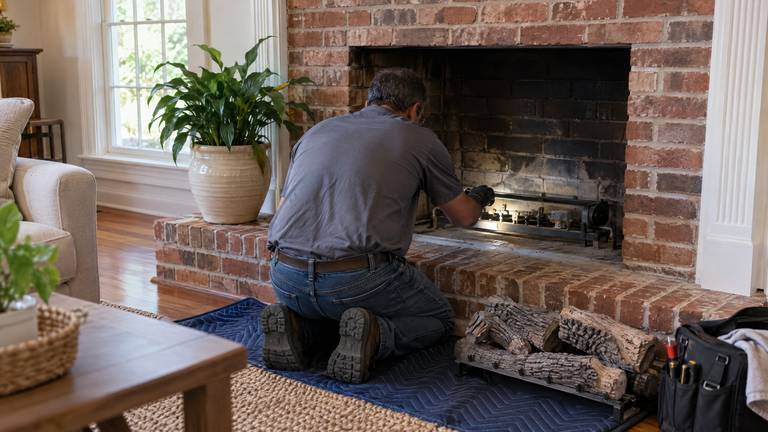
When this kind of system fails, the fault can sit in the spark, the flame sensor, the module, the wiring or the power supply. We work through the sequence the manual gives for that model, so the part replaced is the part that failed.
Black soot on the glass or the logs
Soot inside a gas fireplace is a symptom with a cause. One maker's troubleshooting guide lists flame striking the media, a blocked or misadjusted air shutter, an input rate that is too high, a broken door gasket and leaking vent joints. Each of these changes how cleanly the gas burns.
Cleaning the glass removes the evidence without fixing the fault, so we look for the cause first. If soot appears outside the firebox, on the wall or the ceiling, stop using the fireplace until it has been checked. We clean the deposits once the reason for them has been corrected.
A flame that looks wrong
The flame itself tells a technician a lot. One maker's troubleshooting guide links a blue, lazy and transparent main flame to a blocked vent, and flames that are consistently too large or too small to a burner running above or below its rated input. Flame that lifts off the burner or curls out of the front opening is another sign to stop and have it checked.
We compare the flame with the manual's description, measure pressures if needed and check the air shutter, which that maker says must return to its specified opening. Please leave the shutter and the pressure settings alone, since both are set for the specific fuel and model.
Carbon monoxide alarms near a gas fireplace
You cannot see or smell carbon monoxide, which is why most homes get no warning without an alarm. The U.S. Consumer Product Safety Commission wants carbon monoxide alarms outside sleeping areas and on every level of the home, running on batteries or with battery backup. One fireplace maker also recommends a detector in the same area as the appliance.
When an alarm sounds, everyone goes outside and 911 is called from there, before anyone thinks about the fireplace. Once the house is safe, a service visit can check the appliance, the vent and the seals for anything that could be releasing exhaust. We can also point out sensible alarm positions near the fireplace, following that placement advice.


